


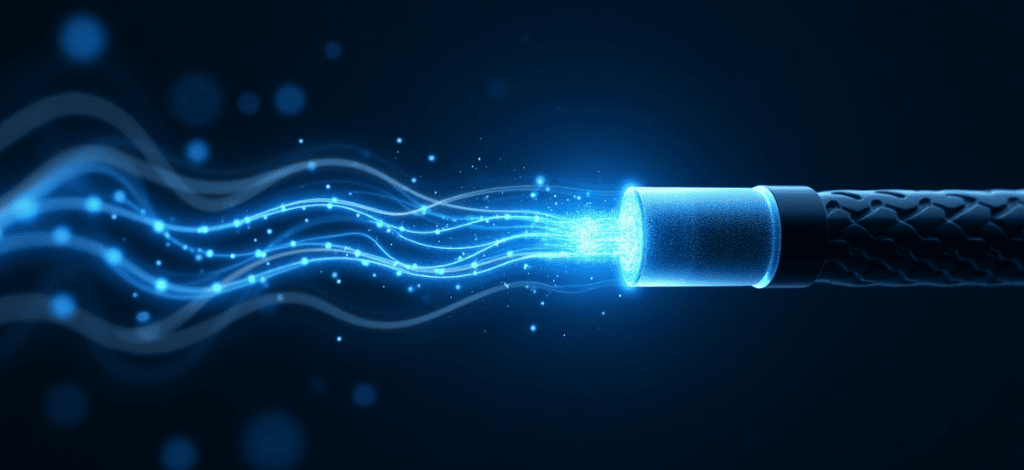
Technology is moving at lightning speed, but sometimes it takes a giant leap instead of small steps. Microsoft’s latest achievement in fiber optics is one of those leaps. The company has developed a hollow core fiber that beats traditional glass fibers in both speed and efficiency, delivering the lowest signal loss ever recorded. This breakthrough could completely change how we move data around the world.
What is Hollow Core Fiber (HCF)?
A hollow core fiber, or HCF, is a type of optical fiber that uses air or a vacuum in the center instead of solid glass. Unlike conventional fibers where light travels through glass, in HCF, the light moves through the empty space at the center. This change might sound simple, but it makes a world of difference in performance.
How Hollow Core Fiber Works
The magic lies in the design. The hollow core is surrounded by a carefully engineered glass structure called cladding. This cladding uses advanced techniques, like photonic bandgap or anti-resonant guiding, to trap the light and keep it moving along the fiber without escaping. The result is faster, cleaner, and more efficient transmission.
Microsoft’s Breakthrough in Hollow Core Fiber
Microsoft’s Azure team, along with researchers from the University of Southampton, achieved something no one else has done before. They reduced data transmission loss to just 0.091 dB per kilometer. This is a huge improvement compared to the long-standing glass fiber limit of around 0.14 dB/km. To top it off, they tested this over 1,200 km of fiber already carrying live traffic.
Historical Challenges of Fiber Optics
Since the 1970s, scientists have been trying to push the limits of fiber optics. But despite decades of progress, glass fiber has hit a wall in terms of performance. Loss rates barely improved over the last 40 years, making it difficult to handle the growing demand for faster and larger data transfers.
Why Hollow Core Fiber is Faster
The answer lies in physics. Light travels faster in air than in glass because air has a lower refractive index. In numbers, it’s about a 45% speed boost. That means data can travel quicker, reducing delays and making real-time applications smoother than ever.
Key Characteristics and Benefits
Hollow core fiber isn’t just about speed. It brings several important benefits:
-
Ultra-low latency for time-sensitive applications
-
Minimal signal distortion because of reduced non-linearity
-
Wider bandwidth, which means more data capacity
-
Lower chromatic dispersion, which simplifies equipment and reduces power usage
Applications of Hollow Core Fiber
The uses for this technology are almost endless. In financial trading, every millisecond counts, and hollow core fiber could provide the edge. Next-generation networks and AI data centers will benefit from higher speeds and efficiency. Virtual reality, gaming, remote surgery, and even self-driving cars need low latency, and HCF is perfect for all of them.
Microsoft’s Acquisition of Lumenisity
Back in 2022, Microsoft acquired Lumenisity, a spin-out company from the University of Southampton. This gave Microsoft access to early hollow core technology and a state-of-the-art production facility in the UK. At the time, hollow core fiber wasn’t commercially ready, but Microsoft’s investment helped bring it to life.
Comparisons with Other Industry Trials
Microsoft isn’t alone in exploring hollow core fiber. Comcast tested a 40 km link in Philadelphia, reporting 150% faster data with 33% lower latency. BT experimented with it for 5G and quantum networks. In Europe, euNetworks deployed it across data centers. All these trials show that the technology works, but Microsoft’s large-scale rollout is unmatched.
Manufacturing Challenges
One of the biggest hurdles is making these fibers at scale. The structure is much more complex than traditional fibers, requiring ultra-thin membranes just 500 nanometers thick. This calls for specialized machinery and high-precision processes. Microsoft is investing heavily to overcome these challenges and automate production.
Cost Savings and Energy Efficiency
Hollow core fiber could also save money and energy. Since signals travel longer without losing strength, networks can use fewer amplifiers, which are both expensive and power-hungry. This not only cuts costs but also makes networks greener and more sustainable.
Market Availability Timeline
Right now, Microsoft is using the technology for its own Azure network. According to researchers, it may take around five years before we see commercial availability for data centers and service providers worldwide. Standardization and production scaling are the main barriers to broader adoption.
Future of Hollow Core Fiber
The future looks bright for HCF. Researchers believe losses could drop even further, maybe as low as 0.018 dB/km with better designs. That would make it even more powerful than today’s record. As production grows, more industries—from AI and cloud computing to quantum communications—will benefit from this game-changing innovation.
Conclusion
Microsoft’s hollow core fiber breakthrough is more than just a technical achievement—it’s the beginning of a new era in telecommunications. Faster speeds, lower latency, wider bandwidth, and greener networks are now within reach. If scaled successfully, this could be one of the biggest leaps forward since the invention of fiber optics itself.
FAQs
1. What makes hollow core fiber better than traditional glass fiber?
It uses air instead of glass for light transmission, making data travel faster and with less signal loss.
2. How much faster is hollow core fiber compared to regular fiber?
It can be up to 45% faster, thanks to the lower refractive index of air.
3. When will hollow core fiber be available to the public?
Microsoft is already using it internally, but broader availability is expected in about five years.
4. What industries will benefit most from hollow core fiber?
Finance, AI, gaming, VR, healthcare, and telecommunications will see the biggest advantages.
5. What are the main challenges in scaling this technology?
Complex manufacturing processes and the need for specialized equipment are the biggest hurdles.
Read more blogs: Alitech Blog

Zeeshan Ali Shah is a professional blog writer at AliTech Solutions, and Realancer renowned for crafting engaging and informative content. He holds a degree from the University of Sindh, where he honed his expertise in technology. With a keen eye for detail and a passion for staying up-to-date on the latest tech trends, Zeeshan’s writing provides valuable insights to his readers. His expertise in the tech industry makes him a sought-after writer, and his work at AliTech Solutions has earned him a reputation as a trusted and knowledgeable voice in the field.



Leave a Reply