


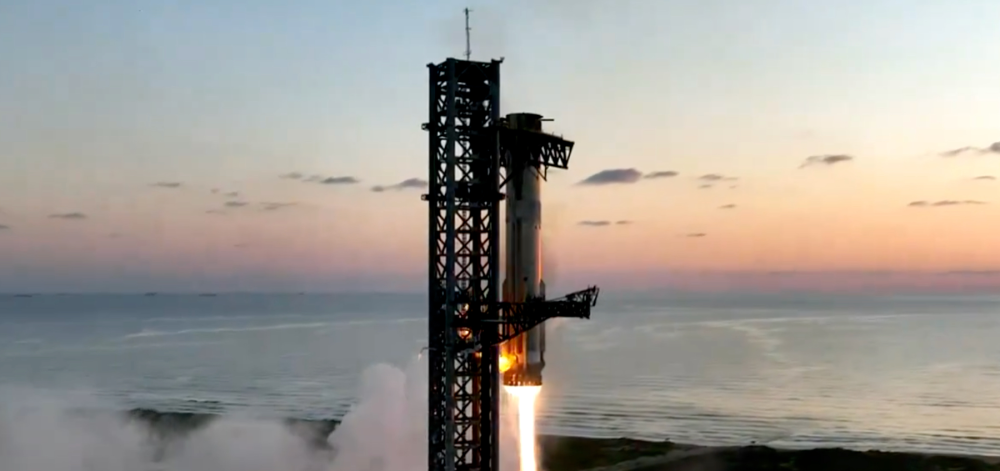
Elon Musk’s SpaceX Achieves a Major Milestone: Catching the Starship Booster Mid-Air
On October 13, 2024, SpaceX marked a monumental achievement in its pursuit of advancing space exploration. The company successfully managed to catch the Super Heavy booster—one of the key components of its Starship rocket system—mid-air during its landing. This groundbreaking event took place using SpaceX’s custom-designed “Mechazilla” arms, an extraordinary engineering tool that allows the booster to be captured before it hits the ground. This achievement pushes the boundaries of what is possible in space travel, bringing humanity closer to fully reusable rockets, which are essential for reducing costs and making space travel sustainable for the long term.
SpaceX’s Dream of Reusability
The vision of reusable rockets has been at the heart of SpaceX’s mission since the company’s inception. Unlike traditional rockets that can only be used once and are discarded after completing their mission, SpaceX’s goal is to develop rockets that can be recovered, refurbished, and launched again. This concept is critical because reusing rockets could significantly lower the cost of space travel, making it more accessible and frequent. Elon Musk and his team have been pursuing this dream for years, with the eventual goal of making space travel as routine and cost-effective as air travel. Catching the Super Heavy booster mid-air is a critical step towards realizing that dream.
Super Heavy-Starship Rocket System
The Starship system is designed to be a fully reusable spacecraft capable of carrying humans, cargo, and even satellites into space and back. The system is made up of two major parts: the Super Heavy booster and the Starship upper stage. Together, they form the most powerful space transportation system ever built. The Super Heavy booster, which is the first stage, is responsible for lifting the second stage, Starship, into space. After completing its mission, the booster is meant to return to Earth to be reused for future flights. The successful capture of this massive booster on October 13 shows just how far SpaceX has come in achieving this goal.
What is Super Heavy?
Super Heavy is the giant first stage of the Starship rocket system, standing about 70 meters tall. It is powered by 33 Raptor engines, which burn methane as fuel, providing it with enough power to lift the Starship upper stage into space. This booster is essential for carrying the upper stage and any payloads, including crew members, to their destination beyond Earth. Once it has completed its mission, Super Heavy is designed to return to Earth, where SpaceX intends to reuse it for multiple flights. This is a critical part of the company’s strategy for reducing the cost of space missions. The successful catch of Super Heavy using Mechazilla marks a major milestone in SpaceX’s progress toward making the booster fully reusable.
Starship Upper Stage
While the Super Heavy booster is responsible for lifting the Starship rocket into space, the Starship upper stage is the part that actually travels to space destinations. This upper stage is designed for a wide range of missions, from transporting satellites to delivering astronauts and cargo to the Moon, Mars, and beyond. Starship is a versatile spacecraft that will play a key role in future human space exploration. It is also designed to return to Earth safely, just like the booster. Together, the Super Heavy booster and Starship form a revolutionary rocket system that will change the future of space travel.
Why Reusability Matters in Space Exploration
The concept of reusability is critical in making space exploration more affordable and sustainable. Traditional rockets are incredibly expensive to manufacture, and because they can only be used once, each mission costs hundreds of millions of dollars. This makes space travel an expensive and rare endeavor. However, if rockets can be reused, the cost of each mission will drop significantly, opening up new possibilities for exploration, research, and even commercial space travel. The successful capture of the Super Heavy booster mid-air is an important step towards realizing this vision. By reusing rockets, SpaceX aims to make space travel as frequent and affordable as air travel, bringing us closer to a future where human beings can explore and settle on other planets.
How the “Mechazilla” Arms Work
Catching a rocket mid-air is an incredibly complex and challenging task. To achieve this, SpaceX developed a specialized tool known as the “Mechazilla” arms. These arms, also nicknamed the “chopsticks,” are attached to a towering launch structure that is even taller than the Statue of Liberty. The purpose of these arms is to catch the Super Heavy booster as it descends back to Earth. The booster’s engines slow it down, and the arms are designed to grab it before it can land or crash. This process eliminates the need for landing gear on the booster and reduces the wear and tear that a typical landing would cause. It also allows the booster to be captured more precisely, reducing the risk of damage and making it easier to reuse.
Catching a Falling Booster
The process of catching a rocket mid-air presents a number of engineering challenges. First, the booster must descend at the right angle and speed for the Mechazilla arms to catch it successfully. Any miscalculation in the descent could lead to the booster missing the arms, which would result in damage to the rocket and possibly the tower itself. The precision required to pull off this maneuver is extraordinary. The booster must ignite a few of its engines as it nears the launch tower to slow its fall, and the arms must close around it at just the right moment. This process requires cutting-edge software, sophisticated hardware, and a deep understanding of physics and engineering to achieve. SpaceX’s successful catch of the Super Heavy booster using the Mechazilla arms is a testament to the company’s ability to solve some of the most difficult problems in space travel.
The Test Flight: Details
The successful catch of the Super Heavy booster took place during a test flight from SpaceX’s launch site in Boca Chica, Texas. The rocket system, standing 397 feet tall, roared into the sky powered by its 33 Raptor engines. Three minutes into the flight, the Super Heavy booster separated from the Starship upper stage. While Starship continued its journey into space, the booster began its controlled descent back toward Earth. Using a series of engine burns, the booster slowed its descent as it approached the launch tower. At the last moment, the Mechazilla arms closed around the falling rocket and captured it mid-air, marking the first time in history that a rocket of this size had been caught before landing.
The Historic Mid-Air Catch
The success of this mission hinged on the flawless execution of this mid-air catch. While SpaceX had been developing and testing the Mechazilla system for some time, this was the first time it was used to capture a rocket of such size and complexity. The precision required for this catch cannot be overstated—the booster had to descend at just the right speed and angle, and the arms had to grab it at exactly the right moment. The fact that SpaceX was able to pull off this maneuver is a major milestone not only for the company but for the future of space exploration as a whole. This successful catch brings SpaceX one step closer to achieving its goal of fully reusable rockets.
The Importance of This Achievement
This achievement is a game-changer for space exploration. By successfully catching the Super Heavy booster mid-air, SpaceX has proven that it is possible to recover and reuse large rocket boosters, which will dramatically reduce the cost of future missions. Reusability is critical for making space travel sustainable in the long term. Each time a rocket is reused, the cost of the next flight goes down. This could open up new possibilities for exploration, research, and commercial missions, making space travel more accessible to both governments and private companies. Additionally, reducing the number of rockets that have to be built for each mission will lower the environmental impact of space exploration.
Starship’s Success in Orbit
While the Super Heavy booster was being caught back on Earth, the Starship upper stage continued its journey into orbit. After separating from the booster, Starship accelerated to speeds of around 17,000 miles per hour, eventually reaching orbit. This marks another success for the Starship system. After completing its mission, Starship safely re-entered Earth’s atmosphere and splashed down over the Indian Ocean. This successful flight demonstrates that both parts of the Starship system—Super Heavy and Starship—are capable of completing their respective missions, further paving the way for future space exploration.
Elon Musk’s Response
Elon Musk, the visionary behind SpaceX, was quick to celebrate the success of this mission. He took to social media to express his excitement, calling it a “huge step forward” in the company’s mission to make space travel more affordable and sustainable. Musk has always been driven by the dream of making life multiplanetary—allowing humans to live and thrive on other planets, particularly Mars. This successful catch of the Super Heavy booster is a key part of that vision, as reusable rockets will be essential for reducing the cost of missions to the Moon, Mars, and beyond.
What’s Next for SpaceX?
While this mission was a resounding success, it is only the beginning. SpaceX will continue to test and refine its reusable rocket systems to ensure they can be used consistently and safely for future missions. The company will likely conduct more test flights to perfect the process of catching the booster and recovering Starship. Each successful test brings SpaceX closer to launching human missions using the Starship system. Before that can happen, SpaceX will need to demonstrate that the rocket system is reliable and safe for crewed missions.
SpaceX’s Role in Lunar Exploration
SpaceX is already playing a critical role in NASA’s plans to return humans to the Moon. The company has been contracted to develop the Starship Human Landing System (HLS) for NASA’s Artemis III mission, which will land astronauts on the Moon for the first time since the Apollo era. Starship is seen as an ideal vehicle for lunar exploration because of its reusability, size, and ability to carry large payloads. If the Artemis mission is successful, Starship could become the go-to vehicle for future lunar exploration missions.
Future Plans: Mars and Beyond
While lunar missions are an important part of SpaceX’s immediate future, Elon Musk’s ultimate goal is to establish a human colony on Mars. Starship is designed to be capable of carrying large numbers of people and cargo to the Red Planet, and the company is already working on the technology that will be needed to build a sustainable colony there. The success of this recent mission brings SpaceX one step closer to sending humans to Mars. The reuse of rockets like Super Heavy will be critical for making these missions cost-effective, as multiple launches will be required to transport supplies, equipment, and settlers to Mars.
The Significance of SpaceX’s Innovation
SpaceX’s successful catch of the Super Heavy booster is a historic moment for space exploration. It demonstrates the company’s ability to innovate and solve complex engineering challenges, paving the way for a future where space travel is more affordable and accessible than ever before. This achievement also brings humanity closer to a future where exploration of the Moon, Mars, and beyond becomes a reality. Through its relentless pursuit of innovation, SpaceX is changing the way we think about space travel, and this mission is a key milestone in that journey.
FAQs
Source: Google News
Read more blogs: Alitech Blog

Zeeshan Ali Shah is a professional blog writer at AliTech Solutions, and Realancer renowned for crafting engaging and informative content. He holds a degree from the University of Sindh, where he honed his expertise in technology. With a keen eye for detail and a passion for staying up-to-date on the latest tech trends, Zeeshan’s writing provides valuable insights to his readers. His expertise in the tech industry makes him a sought-after writer, and his work at AliTech Solutions has earned him a reputation as a trusted and knowledgeable voice in the field.