


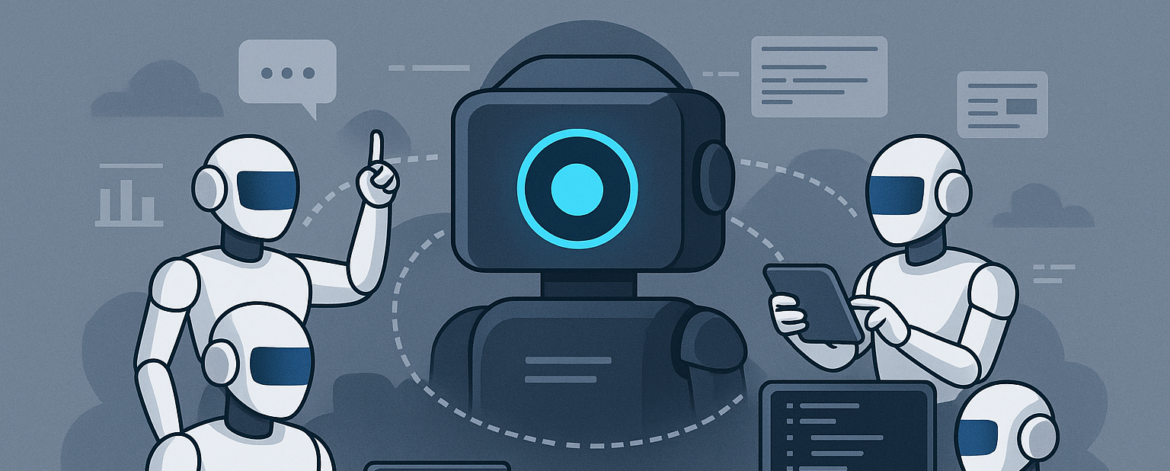
As technology pushes boundaries in 2025, AI agents and autonomous AI are quickly emerging from research lab curiosities into practical, transformative tools. From AI copilots writing code to systems making decisions without human input, the rise of autonomous AI systems is revolutionizing how we live, work, and create.
In this blog post, you’ll learn:
-
What AI agents and autonomous AI are
-
Real-world examples like “AI software engineers”
-
Benefits and challenges
-
Future outlook and practical applications
🤖 What Are AI Agents & Autonomous AI?
Understanding AI Agents
An AI agent is a piece of software or a system designed to perceive its environment, plan actions, and execute tasks towards a goal—often without continuous human guidance. These agents can be as simple as a task-specific chatbot or as advanced as multi-agent systems capable of collaboration and reasoning.
Popular terms like “autonomous AI” and “intelligent agents” refer to systems that can act, learn, and adapt without requiring constant human supervision.
Rise of Autonomous AI Systems
Autonomous AI systems leverage cutting-edge algorithms—especially from natural language processing, machine learning, reinforcement learning, and planning. Rather than answering prompts, these systems proactively identify goals, gather data, make decisions, and take actions to accomplish them.
🛠️ Real-Life Examples of AI Agents
AI Software Engineer – Devin AI & Beyond
In early 2025, Devin AI made headlines as one of the first AI software engineers actively contributing code to open-source projects. This is not fictional—Devin AI autonomously explores issue trackers, suggests fixes, and refines Pull Requests, guided by reinforcement learning models and code evaluation frameworks.
Other systems like AutoGPT and BabyAGI extend this concept. They chain tasks—such as “analyze this dataset,” “write a SQL query,” “test the output”—without human oversight.
AI Agents in Everyday Applications
Autonomous AI isn’t just for coding:
- Customer Service Bots: AI agents equipped with large language models can interpret customer queries, access databases, initiate refunds, and escalate issues—all seamlessly.
- Smart Home Control: Voice-activated agents learn household preferences, automate routines, predict needs, and optimize energy consumption.
- Autonomous Research Assistants: Tools scan academic papers, summarize key findings, propose hypotheses, and compile reports with minimal human input.
These examples illustrate how autonomous AI is shifting from niche use cases to widespread, productivity-enhancing tools.
✅ Benefits of Autonomous AI
Boosted Productivity & Efficiency
AI agents handle routine and repetitive tasks—like writing code, summarizing reports, responding to emails—faster and more consistently than humans. This frees up professionals to focus on creative problem-solving and high-level strategy.
Continuous Learning & Adaptation
Most autonomous AI systems incorporate reinforcement learning, allowing them to learn and improve over time. Each task performed—whether debugging code or handling a customer request—refines their models for better future performance.
Around-the-Clock Availability
Unlike humans, autonomous systems are always operational. Global teams and businesses gain from 24/7 productivity, where tasks progress even after standard work hours.
⚠️ Challenges & Ethical Considerations
Accuracy and Over-Reliance
Even state-of-the-art agents can misinterpret context or propose incorrect solutions. Relying on autonomous systems without oversight—especially for mission-critical tasks—can lead to errors or security vulnerabilities.
Bias & Accountability
Learning models that have been trained on past data may be biased. Autonomous AI decisions—such as loan approvals, hiring filters, or legal recommendations—must be regularly audited for fairness and transparency.
Job Market Disruption
While autonomous AI boosts efficiency, it also raises concerns about job displacement. Roles heavily centered on routine tasks—like code maintenance or data entry—might shrink. However, it simultaneously creates new job roles like AI system supervisors, agent trainers, and AI ethicists.
🌍 Future of AI Agents & Autonomous AI
Multi-Agent Ecosystems
The future likely involves multiple autonomous AI agents collaborating on complex tasks. Picture an AI research team—one agent gathers data, another analyzes it, a third prepares presentations—demonstrating a coordinated approach to problem-solving.
Human‑in‑the‑Loop Systems
The most effective systems will likely be human‑in‑the‑loop: autonomous AI agents handle routine tasks, while humans supervise, validate, and guide strategy. This hybrid strategy strikes a compromise between supervision and efficiency.
Ethical & Regulatory Frameworks
As autonomous AI permeates society, governments and organizations must establish regulations to ensure safety, fairness, and accountability. Topics like AI transparency, explainability, and model testing will rise to the forefront.
📌 Practical Recommendations for Tech Bloggers
Here’s how you can leverage this trend in your content:
-
Engaging Titles: “Are Autonomous AI Agents Replacing Developers?”, “How AI Software Engineers Like Devin AI Are Changing Coding”
-
Strategic Keywords: Integrate terms like “AI agents,” “autonomous AI systems,” “AI in development,” and “AI software engineer” within headings, intro, body, and meta descriptions.
-
Multimedia Support: Include diagrams showing decision cycles, or screenshots of agent-enabled development tools.
-
Case Studies: Reference specific real-world examples—like Devin AI or AutoGPT—to ground theory.
-
SEO Extras: Add internal links to deeper technical guides, external links to academic papers, and answer user queries like “What is an autonomous AI agent?” or “Are AI agents secure?”
The development of AI agents and autonomous AI represents a significant change from tools that react to commands to systems that are capable of independent thought, action, and adaptation. This trend heralds breakthroughs in coding, customer service, research, and everyday automation. But it also raises important questions about responsibility, bias, and job transformation.
For bloggers and content creators, this is fertile ground for compelling, SEO-rich content. Whether you cover the rise of AI software engineers, explore the pros and cons of autonomous AI systems, or speculate about multi-agent ecosystems, there’s no shortage of engaging angles.
❓ Frequently Asked Questions (FAQs)
Q1. What are AI agents?
A: AI agents are intelligent systems capable of perceiving their environment, making decisions, and taking actions to achieve specific goals—often without human supervision. Examples include virtual assistants, autonomous bots, and task-performing AI systems like AutoGPT.
Q2. How does autonomous AI differ from traditional AI?
A: Traditional AI systems require direct input and instruction from users. In contrast, autonomous AI can operate independently, learn from experiences, and perform complex tasks across multiple steps with minimal human intervention.
Q3. What is Devin AI, and why is it important?
A: Devin AI is one of the first known AI software engineers. It can understand code issues, suggest solutions, and contribute to development autonomously—marking a major advancement in AI-assisted software engineering.
Q4. Where are autonomous AI systems used in real life?
A: Autonomous AI is used in various industries:
-
In customer service (AI chatbots)
-
Software development (AI coding agents)
-
Smart homes (personal assistants)
-
Finance (automated advisors and fraud detection)
Q5. Are AI agents replacing human jobs?
A: While AI agents may automate routine tasks, they are also creating new roles like AI supervisors, trainers, and ethicists. The future trend points toward collaboration, not full replacement.
Q6. Is autonomous AI safe and ethical to use?
A: Like any technology, it depends on implementation. Ensuring safety requires transparency, ethical training data, human oversight, and adherence to AI regulations to prevent bias and misuse.
Read more blogs: Alitech.io
Realancer is a flexible freelancing platform built of real life. Whether you want to work part-time , weekend , or just when you are free , Realancer lets you offer locally or remotely – on your own terms. Fair flexible and built for freelancers and clients alike.
Join the waiting list now: https://app.realancer.net/