


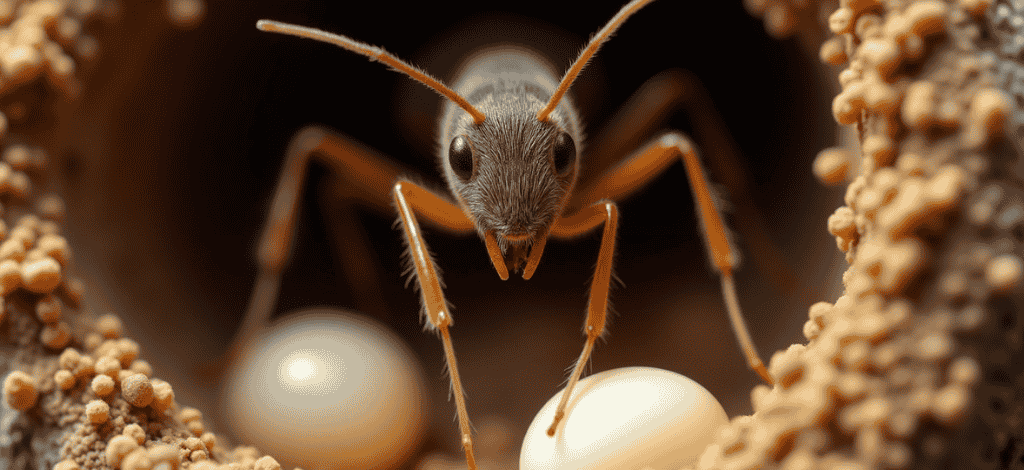
Imagine one mother giving birth to two completely different species. It sounds like something out of science fiction, right? But in the insect world, reality is often stranger than fiction. Scientists recently discovered that Iberian harvester ant queens can do exactly that—produce offspring that belong to two distinct species.
The Strange World of Ants
Ants are already known for their complex societies, teamwork, and surprising behaviors. A single queen is responsible for producing all members of a colony, from workers to future queens and males. But the Iberian harvester ant has taken reproduction to an entirely new level.
Meet the Iberian Harvester Ant
The Iberian harvester ant, also known as Messor ibericus, is found in parts of Europe, especially around the Mediterranean. These ants specialize in collecting seeds and building massive underground colonies. But now, they’re famous for something else—their queens can give birth to another species entirely.
A Shocking Discovery
Researchers were puzzled when they studied Iberian harvester ants in Sicily. The colonies seemed to contain not just one, but two species of ants. The problem? The nearest population of the second species, Messor structor, was hundreds of miles away. How was this possible?
How One Queen Produces Two Species
The mystery deepened when scientists realized that the queens of Messor ibericus were somehow producing not only their own offspring but also ants of another species. Some eggs developed into typical Iberian harvester ants, while others developed into what looked like Messor structor ants.
The Role of Hybrid Worker Ants
Most colonies were filled with worker ants that were actually hybrids—offspring with mixed DNA. These hybrids formed the backbone of the colony, doing the majority of the work like collecting seeds, building tunnels, and protecting the nest.
The Missing Species Mystery
For years, scientists thought the Iberian ants must be mating with nearby Messor structor populations to create these hybrids. But the absence of structor colonies nearby forced them to think again. The answer lay in the queen’s unusual ability.
Scientific Investigations and Experiments
To solve the puzzle, scientists studied over 120 ant populations across Europe. They sequenced genomes, analyzed thousands of ants, and even raised colonies in laboratories for years. The conclusion was shocking—one queen could indeed produce two different species.
The Concept of Xenoparity
This new reproductive strategy was named xenoparity. The word comes from “xeno,” meaning strange or foreign, and “parous,” meaning to give birth. It describes the ability of one species to give birth to another. This is the first confirmed case of xenoparity in the animal kingdom.
Cross-Species Cloning Explained
Here’s how it works: Iberian harvester queens use stored sperm from Messor structor males. But instead of normal fertilization, they somehow delete their own DNA from the egg, allowing only the foreign DNA to develop. This means the queen is literally cloning males of another species.
Evolutionary Background: Two Species That Split
Interestingly, Messor ibericus and Messor structor were once the same species over five million years ago. Over time, they split into two. But the Iberian queen’s unique ability kept their evolutionary connection alive in a strange way.
Why Queens Lost the Ability to Make Workers
At some point, Iberian queens lost the genetic ability to produce their own worker ants. Scientists don’t know exactly why, but one theory suggests genetic conflict inside colonies forced evolution to take this odd turn.
Sperm Parasitism and Its Role
Before they developed cloning abilities, Iberian queens depended on structor males for survival. This process, called sperm parasitism, meant they had to seek out another species’ sperm to survive.
Domestication of Males
Over time, Iberian queens gained control over structor sperm, almost like humans domesticating livestock. Instead of chasing males across miles, they cloned them right inside their nests. This saved time and ensured survival.
Lab Observations and Findings
In controlled nests, scientists directly observed queens producing both hairy Iberian males and hairless structor males from the same batch of eggs. It was the clearest proof yet that one mother could truly give birth to two species.
Genetic Surprises from DNA Sequencing
DNA tests confirmed the shocking reality. Pure Iberian ants carried only Iberian genes. But hybrid workers had mixed DNA, and cloned structor males were almost perfect copies of structor ants—with a tiny trace of Iberian genetic material in their mitochondria.
The Difference Between Hairy and Hairless Ants
A simple way to tell them apart is by their body hair. Iberian ants are hairy, while structor ants are nearly hairless. This physical trait provided researchers with an easy way to separate the two in their experiments.
Why Hybrid Workers Dominate Colonies
Interestingly, 99% of the colony is made up of hybrid workers. They are stronger, more adaptable, and provide a competitive edge for the Iberian ants, allowing them to spread across the Mediterranean.
Impact on the Mediterranean Ecosystem
Because of their massive hybrid workforces, Iberian harvester ants have spread widely, sometimes outcompeting other local species. Their unique reproduction strategy makes them highly adaptable invaders.
Possible Future of Iberian Harvester Ants
While this strategy seems powerful, it may also have a downside. Cloning reduces genetic diversity, and over time, this could make the species vulnerable to disease or extinction. Some scientists believe that in a few million years, they might disappear.
Challenges in Understanding the Mechanism
Scientists are still puzzled about how exactly the queen deletes her own DNA. They know it happens, but not when or how during egg development. Unlocking this mystery could provide new insights into cloning in other animals.
What Scientists Plan to Study Next
The next step is to investigate the cellular process behind cross-species cloning. If scientists can understand it fully, it could transform our knowledge of genetics and reproduction.
Why This Discovery Matters to Evolutionary Biology
This finding challenges basic rules of biology. It shows that reproduction can bend in ways we never imagined. Ants are proving once again that nature is far more inventive than we think.
Comparisons with Other Insects and Animals
Other ants are known for hybrid offspring or cloning, but never across species. This discovery puts Iberian harvester ants among the most unusual insects ever studied.
Conclusion
The discovery of ant queens that can give birth to two different species is rewriting biology books. By cloning males of another species and producing hybrid workers, Iberian harvester ants show us just how creative evolution can be. It’s a reminder that the natural world still holds secrets stranger than fiction—and we’ve only scratched the surface.
FAQs
1. Can Iberian harvester ants produce their own workers?
No, they rely on hybrid workers created from cloned sperm of another species.
2. What does xenoparity mean?
It means giving birth to another species, a phenomenon first discovered in Iberian harvester ants.
3. How can scientists tell the two species apart?
By physical traits like hair—Messor ibericus is hairy, while Messor structor is hairless.
4. Why is cloning risky for ants?
Cloning reduces genetic diversity, making species more vulnerable to extinction in the long run.
5. Could this discovery impact human cloning research?
Yes, studying natural cloning in ants may provide insights that could help scientists explore cloning in other animals.
Read more blogs: Alitech Blog
Tags: ant queens gives birth to two species, iberian harvester ant queens discovery, ant queens messor ibericus reproduction, xenoparity in ant queens, cross species cloning ant queens, hybrid worker ant queens study, ant queens cloning males, ant reproduction evolutionary biology, strange ant survival strategies, cloning in insect species, ant genetics and cloning research, scientists discover new ant queens reproduction, ant queen sperm parasitism, unusual ant life cycle, ant cloning nature study

Zeeshan Ali Shah is a professional blog writer at AliTech Solutions, and Realancer renowned for crafting engaging and informative content. He holds a degree from the University of Sindh, where he honed his expertise in technology. With a keen eye for detail and a passion for staying up-to-date on the latest tech trends, Zeeshan’s writing provides valuable insights to his readers. His expertise in the tech industry makes him a sought-after writer, and his work at AliTech Solutions has earned him a reputation as a trusted and knowledgeable voice in the field.