


Apple’s Unique Approach to Artificial Intelligence
The tech giant has always taken a different path compared to other companies, and its entry into artificial intelligence is no exception. Instead of chasing hype or building the largest models just for the sake of competition, the company is focusing on creating meaningful and practical AI experiences for users. Its strategy revolves around integrating AI deeply into everyday tasks, making it feel less like a tool and more like a natural extension of how people interact with their devices. This approach allows Cupertino to stand out in a crowded AI market where many companies prioritize scale over usability.
WWDC 2026 Marked a Major Turning Point
At its Worldwide Developers Conference 2026, Apple revealed its most ambitious AI advancements yet, signaling a major shift in its technological direction. The event showcased a redesigned Siri, enhanced AI capabilities, and a new cloud-based intelligence system that works seamlessly with on-device processing. This wasn’t just another product update; it was a clear statement that the company is now fully committed to competing in the AI space. The demonstrations highlighted how AI can simplify complex tasks, improve productivity, and create more personalized user experiences. The announcements also emphasized that the journey into AI is just beginning, with more innovations expected in the near future.
Apple Intelligence Brings AI to Everyday Life
The company introduced a new concept called Apple Intelligence, which acts as the foundation for all its AI-powered features. This system is designed to understand user context, preferences, and behavior, allowing it to deliver highly personalized experiences. Unlike traditional AI systems that rely heavily on cloud processing, it combines on-device computing with cloud-based models when needed. This hybrid approach ensures both efficiency and privacy, giving users the best of both worlds. Whether it’s managing schedules, summarizing messages, or assisting with creative tasks, Apple Intelligence aims to make technology more intuitive and human-like.
Strategic Partnership with Google and Nvidia
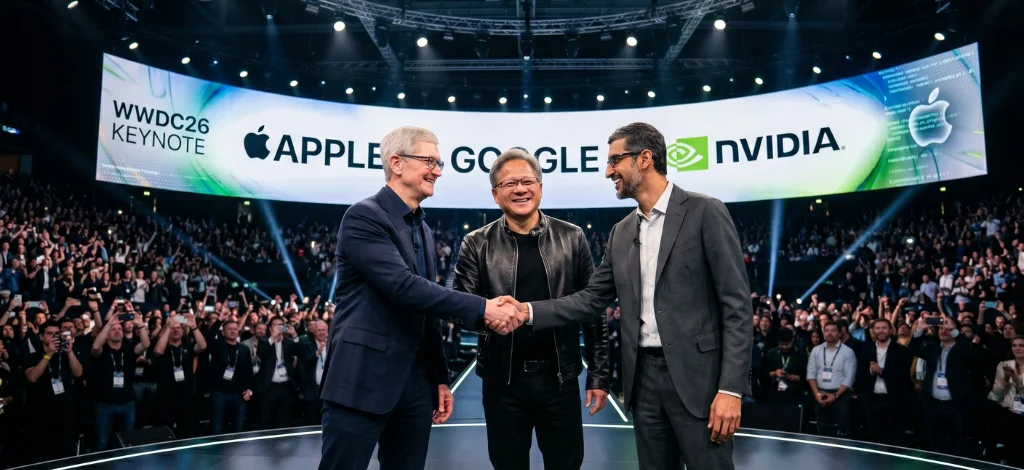
One of the most surprising aspects of the AI strategy is its collaboration with Google and Nvidia, two of the biggest names in the industry. Instead of building everything from scratch, Cupertino chose to leverage the strengths of these companies to accelerate progress. Google’s expertise in AI models and Nvidia’s powerful GPUs provide the backbone for the most advanced cloud-based features. This partnership shows that even industry leaders recognize the value of collaboration in pushing technological boundaries. By combining resources and expertise, these companies are creating AI systems that are more powerful and efficient than ever before.
Nvidia GPUs Power the Cloud AI
Nvidia’s graphics processing units play a crucial role in the AI infrastructure, especially for tasks that require significant computational power. These GPUs are used in cloud environments to handle complex AI processes that cannot be efficiently executed on a device. This allows the company to deliver advanced features without compromising performance or battery life. The use of Nvidia technology also ensures that the AI models can scale effectively, handling millions of requests with speed and accuracy. This integration highlights the importance of hardware in achieving cutting-edge AI performance.
Apple Foundation Model Cloud Pro Explained
The most advanced AI model, known as the Apple Foundation Model Cloud Pro, represents a significant leap in the company’s capabilities. This model is designed to handle complex tasks such as language understanding, image generation, and advanced data analysis. It operates in the cloud but is tightly integrated with the broader ecosystem, ensuring seamless performance across devices. What makes this model unique is its ability to deliver results comparable to leading AI systems while maintaining strict privacy standards. This balance between power and privacy is a key differentiator.
A Privacy-First AI Architecture
Privacy has always been a core value, and the AI architecture reflects this commitment. The systems are designed to process as much data as possible directly on the user’s device, minimizing the need to send sensitive information to the cloud. When cloud processing is required, secure methods are used to ensure that user data remains protected. This approach not only builds trust but also sets the company apart from competitors that rely heavily on data collection. By prioritizing privacy, it is addressing one of the biggest concerns associated with AI technology.
The Role of the System Orchestrator
At the heart of the AI system is a component known as the system orchestrator, which acts as a decision-maker for AI tasks. This technology determines whether a request should be processed on the device or sent to the cloud, based on factors such as complexity and data sensitivity. This intelligent routing ensures optimal performance while maintaining privacy and efficiency. The system orchestrator is a key innovation that enables a seamless AI experience without compromising core principles. It essentially acts like a traffic controller, directing tasks to the most appropriate resources.
Siri AI Gets a Massive Upgrade
Siri, the virtual assistant, has undergone a complete transformation with the introduction of advanced AI capabilities. The new Siri can engage in natural conversations, understand context, and perform multi-step tasks with ease. This makes it more than just a voice assistant; it becomes a true digital companion that can assist with a wide range of activities. From setting reminders to planning events, Siri’s enhanced abilities make it a powerful tool for productivity. This upgrade demonstrates a firm commitment to improving user interaction through AI.
Real-Life Use Cases of Siri AI
The improved Siri AI can handle a variety of real-world scenarios, making everyday tasks simpler and more efficient. For example, it can check event schedules, send messages, and provide directions, all within a single conversation. This level of integration allows users to accomplish more without switching between apps. It also adapts to individual preferences, providing personalized suggestions and recommendations. These capabilities highlight how AI can enhance daily life in meaningful ways, rather than just being a novelty feature.
Hardware Requirements for Advanced AI Features
The new AI capabilities come with higher hardware requirements, reflecting the complexity of the technology. Only the latest devices with advanced processors and sufficient memory can support these features. This ensures that users get the best possible performance without compromising speed or reliability. While this may limit access for some users, it also guarantees a high-quality experience for those with compatible devices. The focus on performance over compatibility reflects a dedication to delivering premium technology.
Limited Device Availability
Not all devices will be able to run the new AI features, as some require more powerful hardware than older models can provide. This includes the latest iPhones, iPads, and Macs equipped with advanced chips and higher RAM. By limiting availability, the company ensures that its AI features perform optimally without causing issues such as lag or overheating. This approach may seem restrictive, but it ultimately benefits users by maintaining a consistent experience across supported devices.
Apple vs Google in the AI Race
While the two giants are collaborating on certain aspects of AI, they still have different strategies when it comes to overall implementation. Google focuses on large-scale models and data-driven insights, while Cupertino prioritizes privacy and user experience. This contrast highlights the diverse approaches within the AI industry, each with its own strengths and challenges. By combining elements of both strategies, a unique market position is being established.
Apple vs OpenAI and Other Competitors
Compared to companies like OpenAI and Anthropic, the approach here is more conservative but also more user-focused. Instead of releasing standalone AI tools, intelligence is integrated directly into the ecosystem. This makes AI more accessible and practical for everyday use. While competitors may lead in certain areas, the focus on integration and privacy provides a competitive edge in the long run.
The Future of the AI Ecosystem
This AI journey is just beginning, and a strong foundation for future growth has already been laid. With ongoing advancements in hardware and software, even more powerful features are expected in the coming years. The integration of AI into every aspect of the ecosystem will continue to enhance user experiences and redefine how we interact with technology. This evolution will likely influence the entire tech industry, setting new standards for innovation.
Impact on Users and Businesses
These advancements in AI technology will have a significant impact on both individual users and businesses. For users, it means more intuitive devices that can handle complex tasks effortlessly. For businesses, it opens up new opportunities to leverage AI for productivity, customer engagement, and innovation. This shift highlights the growing importance of AI in shaping the future of technology and society.
Why This AI Strategy Matters
The approach to AI is not just about technology; it’s about redefining how people interact with digital tools. By focusing on privacy, usability, and integration, a new benchmark for the industry is being set. This strategy ensures that AI remains a tool for empowerment rather than a source of concern. As the technology continues to evolve, this influence will play a crucial role in shaping its direction.
Opportunities for Developers and Startups
The introduction of Apple Intelligence creates new opportunities for developers and startups to build innovative applications. By leveraging this AI framework, they can create solutions that are both powerful and user-friendly. This opens up a new ecosystem of possibilities, driving innovation and growth in the tech industry. Developers can now create apps that are smarter, more responsive, and better aligned with user needs.
The Role of Cloud and Edge Computing
The hybrid approach to AI combines the strengths of cloud and edge computing, creating a balanced system that delivers both performance and privacy. Edge computing allows tasks to be processed locally, reducing latency and enhancing security, while cloud computing provides the power needed for more complex operations. This combination ensures that users get the best possible experience without compromising on either speed or safety.
Conclusion: The AI Journey is Just Beginning
The collaboration between Apple, Google, and Nvidia marks a new chapter in the evolution of artificial intelligence. By combining cutting-edge technology with a strong focus on privacy and user experience, the company is redefining what AI can achieve. This approach not only sets it apart from competitors but also positions it as a leader in the next generation of technology. As AI continues to evolve, this strategy will likely shape the future of the industry, influencing how we interact with technology in our daily lives.
FAQs
1. What is Apple Intelligence?
Apple Intelligence is the AI system that combines on-device and cloud processing to deliver personalized and efficient user experiences.
2. Why did the company partner with Google and Nvidia?
The collaboration taps into Google’s AI model expertise and Nvidia’s powerful GPUs to enhance cloud-based AI capabilities.
3. Which devices support the new AI features?
Only the latest iPhones, iPads, and Macs with advanced chips and sufficient RAM support these features.
4. How is this AI different from competitors?
The focus is on privacy and integration, while competitors often prioritize large-scale models and data collection.
5. What is the future of this AI ecosystem?
Continued expansion of AI capabilities is expected, integrating intelligence deeper into the ecosystem and improving user experiences.
Boost your business with AliTech Solutions
If you want to bring powerful artificial intelligence into your business like the world’s top tech companies, AliTech Solutions can help. We provide smart, scalable, and secure AI solutions tailored to your needs. From automation to advanced AI systems, we help you stay ahead in the digital world. Contact us today at [email protected] and start your AI journey with confidence.
Realancer – Free Freelancing, Always! Apply to unlimited projects — no connects, no fees. Work part-time or full-time, remote or local. Join the waitlist: https://realancer.net

Zeeshan Ali Shah is a professional blog writer at AliTech Solutions, and Realancer renowned for crafting engaging and informative content. He holds a degree from the University of Sindh, where he honed his expertise in technology. With a keen eye for detail and a passion for staying up-to-date on the latest tech trends, Zeeshan’s writing provides valuable insights to his readers. His expertise in the tech industry makes him a sought-after writer, and his work at AliTech Solutions has earned him a reputation as a trusted and knowledgeable voice in the field.



Leave a Reply