


The controversy that sparked a global debate
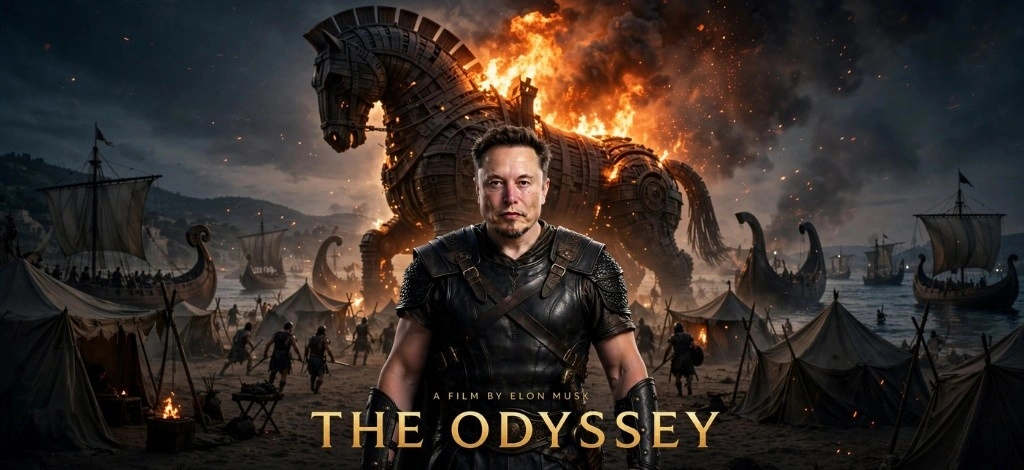
The entertainment world recently witnessed a fascinating clash between technology and traditional filmmaking, and honestly, it feels like something straight out of a sci‑fi movie. Elon Musk boldly claimed that his AI platform, Grok Imagine, will create a full‑length, “historically accurate” version of The Odyssey by the end of the year. This statement came right after Christopher Nolan’s epic adaptation of the ancient Greek tale hit theaters and was hailed as a major, highly anticipated release. Naturally, this sparked intense debates across social media, Hollywood, and academic circles, raising a big question: can artificial intelligence truly outperform one of the greatest filmmakers of our time?
Musk’s bold claim about Grok
Musk didn’t just casually mention this idea; he made a confident promise that Grok Imagine would produce a movie that stays “true to the art of Homer” and aims for historical accuracy. He amplified a short AI‑generated clip, a Grok Imagine trailer featuring AI stand‑ins for Odysseus and Calypso, giving audiences a glimpse of what this AI‑driven future might look like. The claim of “historical accuracy” became the centerpiece of his argument, suggesting that AI could minimize creative biases and deliver a more authentic version of the story. But here’s the twist—many experts and commentators point out that The Odyssey itself isn’t historically factual in the strict sense, which makes the idea of a completely accurate adaptation more complicated than it sounds.
Nolan’s blockbuster success changes the narrative
While Musk was making headlines with his statements, Christopher Nolan was busy dominating the big screen. Nolan’s The Odyssey arrived as a large‑scale, star‑studded epic and quickly became one of the most talked‑about releases of the year, with strong box‑office performance and widespread critical praise. The film drew attention for its ambitious storytelling, striking visuals, and powerful performances, reinforcing the idea that audiences still deeply value human creativity in cinema. Despite criticism and online controversy over certain casting choices, the movie resonated strongly with viewers worldwide. This success makes Musk’s claim even more ambitious, almost like challenging a champion right after they’ve just defended a major title.
The origins of Homer’s epic masterpiece
To truly understand this debate, we need to go back thousands of years to the origins of The Odyssey. Traditionally attributed to the ancient Greek poet Homer, this epic poem emerges from oral traditions that blend myth, legend, and cultural storytelling. It follows Odysseus as he journeys home after the Trojan War, facing gods, monsters, and countless trials along the way—a narrative that has been retold and reshaped over centuries. Because the story evolved through repeated performances and variations, there isn’t a single definitive version of The Odyssey, which complicates Musk’s claim of creating a single “true” or fully accurate adaptation.
Why The Odyssey still matters today
Even after centuries, The Odyssey remains one of the most influential works in world literature. It has inspired countless books, films, and artistic interpretations across cultures, from classic stage productions to modern cinematic epics. Its themes—adventure, loyalty, survival, and the search for home—are universal and timeless, allowing each generation to discover new meaning within the story. Filmmakers like Nolan often choose to reinterpret the epic rather than replicate it, using their own creative lens to connect ancient material with contemporary audiences. This flexibility keeps the myth alive, but it also challenges the idea that there could ever be a single, perfectly accurate version.
Casting choices and the controversy around Nolan’s film
One of the biggest talking points surrounding Nolan’s adaptation has been his casting decisions. Musk and some online critics attacked the film for what they described as a lack of “authenticity” in representing ancient Greek characters, especially around diverse casting choices. Musk amplified complaints that accused the film of compromising historical accuracy for modern sensibilities, framing these choices as disrespectful to Greek cultural heritage. However, many critics and scholars defended Nolan’s approach, pointing out that storytelling has always evolved with cultural context and that earlier adaptations of The Odyssey rarely followed strict historical or ethnic accuracy. In other words, representation and interpretation have always been part of how this myth is retold.
Box office performance proves audience interest
Despite the controversy, Nolan’s film performed strongly at the box office and became one of the year’s standout releases, indicating robust audience interest. The solid opening and continued momentum suggest that viewers are more captivated by emotional storytelling, compelling performances, and immersive visuals than by debates over perfect historical detail. This underscores an important point: audiences often connect with narrative depth and cinematic experience more than with strict adherence to academic accuracy. It’s a bit like choosing between a perfectly accurate map and a beautifully painted landscape—both have value, but one speaks more to the heart.
What exactly is Grok AI?
Grok is an AI platform developed under Musk’s xAI initiatives, designed to generate content such as text, images, and increasingly sophisticated video clips. Grok Imagine, the video generation component, aims to push the boundaries of what AI can achieve in filmmaking by using prompts to create scenes and short trailers. From dialogue to character visuals, Grok Imagine attempts to automate parts of the creative pipeline, reflecting a growing trend where generative AI tools are used for content creation at scale. The big question, however, is whether such systems can move beyond impressive demos to deliver feature‑length films that rival human‑directed cinema.
The promise of historical accuracy through AI
Musk’s argument hinges on the idea that AI can analyze vast amounts of data and produce a more accurate representation of events or source material. Theoretically, an AI system could cross‑reference historical scholarship, archaeological findings, and textual analysis to reconstruct environments, costumes, and cultural details. Yet, when it comes to The Odyssey, the challenge is fundamentally different, because the story is mythic rather than a verified historical account. Trying to make it historically accurate is a bit like trying to fact‑check a dream: you can align with certain academic theories, but you can’t turn a legendary voyage into a documentary.
How AI is reshaping modern cinema
Artificial intelligence is already transforming the film industry in several practical ways. It’s being used for script analysis, production planning, previsualization, visual effects, and even digital de‑aging or environment generation. These tools help filmmakers work faster and more efficiently, tackling sequences that were once prohibitively expensive or technically difficult. Some studios and independent creators are experimenting with fully AI‑generated shorts and trailers, hinting at a future where more of the pipeline can be automated. At the same time, this shift raises concerns about originality, creative control, and how far automation should go in an art form built on human perspective.
The advantages of AI‑generated movies
AI‑generated films offer several potential benefits that are hard to ignore. They can significantly reduce production costs by minimizing the need for large sets, extensive location shoots, and certain labor‑intensive visual effects tasks. AI systems also allow rapid experimentation, enabling creators to test multiple versions of scenes, tones, or visual styles in a fraction of the usual time. Additionally, AI can generate richly detailed environments and complex shots that might otherwise be out of reach for smaller budgets, especially in genres like science fiction and fantasy. For some projects, this could democratize access to high‑end visuals and accelerate the creative iteration process.
The limitations and risks of AI storytelling
Despite its advantages, AI has clear limitations when it comes to storytelling and emotional resonance. AI models work by learning patterns from data, which allows them to mimic styles and structures but doesn’t give them lived experience, intuition, or genuine empathy. They can generate plausible dialogue and dramatic beats, but often struggle with deeper thematic coherence, subtext, and the kind of emotional nuance that comes from human insight. There is also a risk of misinformation or oversimplification when AI recreates historical or cultural narratives, especially if training data or prompts are biased or incomplete. Without careful human oversight, AI‑generated content could unintentionally distort complex stories or reinforce problematic stereotypes.
Can The Odyssey ever be historically accurate?
This is where the debate becomes especially intriguing. Scholars and cultural commentators argue that The Odyssey cannot be historically accurate in a strict sense because it is rooted in mythology and oral tradition rather than a single verified historical record. Over time, storytellers added, removed, and reshaped elements to suit different audiences, which means the epic we know today is the result of many layers of interpretation. Attempting to create one “accurate” version risks ignoring this rich history of adaptation and variation. It’s like trying to identify the original telling of a story that has been passed down for centuries through countless voices—it simply doesn’t exist as a single, fixed text.
Interpretation is the heart of storytelling
Every adaptation of The Odyssey is ultimately an interpretation, not a mechanical replication. Filmmakers, writers, and artists bring their own perspectives, cultural contexts, and creative priorities to the material, shaping how the story speaks to their time. This interpretive freedom is what keeps the epic alive and continuously relevant, allowing it to be reframed around themes like migration, war trauma, or identity. Removing interpretation in favor of rigid accuracy might seem objective but could actually narrow creativity and reduce the story’s emotional impact. The variations and reimaginings are what make The Odyssey fascinating; they allow each new retelling to say something fresh about heroism, home, and loss.
Hollywood’s reaction to Musk’s claim
Musk’s statements did not go unnoticed in Hollywood or the broader creative community. Several filmmakers and industry observers criticized his framing, arguing that he underestimated the complexity of cinema and the role of human authorship. Some questioned whether an AI system can truly understand narrative intent or cultural nuance the way an experienced director does. These reactions highlight a broader tension between technology companies and traditional creative industries: innovation is welcomed, but not at the cost of erasing the human element that defines storytelling. For many, the fear is less about AI tools themselves and more about viewing cinema as something that can be “solved” algorithmically.
Social media fuels the debate
The controversy quickly spread across social media platforms, especially X (formerly Twitter), where Musk’s pinned post announcing the Grok Imagine project drew massive engagement and mixed reactions. Some users enthusiastically supported his vision, seeing it as proof that AI could revolutionize filmmaking and challenge Hollywood’s status quo. Others defended Nolan and human creators, criticizing the Grok trailer as “AI slop” and questioning whether an algorithm could ever match the emotional and artistic depth of a seasoned director. This divide mirrors a larger cultural conversation about the role of technology in art: people are both excited and cautious about how far automation should go in creative domains.
Storytelling depth and emotional connection
One of the biggest differences between AI and human filmmakers lies in emotional storytelling. Human creators draw from personal experiences, cultural memory, and emotional intelligence, allowing them to craft stories that resonate deeply with audiences. They can intuit when a scene needs silence, ambiguity, or a surprising perspective, decisions that often come from instinct rather than a pattern in data. AI, on the other hand, relies on statistical patterns and learned correlations; it can mimic the structure of emotional scenes but doesn’t truly feel or understand them. This gap could be a major challenge for AI‑generated films trying to move from impressive technical demonstrations to enduring works of art.
Can AI truly replace directors?
The idea of AI replacing directors is both thrilling and unsettling for the film industry. While AI can assist in many aspects of filmmaking—such as previsualization, editing suggestions, and effects generation—it is unlikely to fully replace human creativity anytime soon. Directors bring vision, taste, and leadership to a project, coordinating performances, visual language, and thematic coherence in ways that go beyond technical optimization. Current research and industry discussions suggest that the most productive role for AI is as a powerful tool that extends human capability rather than an independent author. In this sense, AI can influence how films are made, but it does not eliminate the need for human storytellers.
The rise of hybrid filmmaking models
A more realistic scenario than full automation is the rise of hybrid filmmaking, where AI tools work alongside human creators. In these models, AI handles repetitive or technical tasks—like generating concept art variations, simulating shots, or analyzing script structure—while directors and writers focus on narrative depth and artistic choices. This approach can lead to more efficient productions without sacrificing human authorship, preserving the director’s role as the primary creative voice. Some experts argue that positioning AI as an “embodiment tool” rather than an autonomous creative partner helps maintain artistic integrity and accountability. If applied thoughtfully, such hybrid workflows could produce films that are both technologically advanced and emotionally rich.
Conclusion: A clash of vision and reality
The debate between Elon Musk and Christopher Nolan isn’t just about one movie—it’s about the future of storytelling itself. On one side, we have cutting‑edge technology promising efficiency, data‑driven precision, and new ways of visualizing epic tales like The Odyssey. On the other, we have human creativity, which thrives on interpretation, emotion, and the messy, subjective nature of art. While AI will undoubtedly play a bigger role in filmmaking, it is more likely to become a powerful collaborator than a full replacement for directors. The Odyssey, in all its evolving forms, will continue to be retold and reimagined, reminding us that stories are meant to be experienced, debated, and felt—not just calculated.
FAQs
1. What did Elon Musk say about The Odyssey?
He claimed that his AI platform Grok Imagine would create a full‑length movie of The Odyssey by the end of the year that is “historically accurate and true to the art of Homer.”
2. How successful was Christopher Nolan’s The Odyssey?
Nolan’s The Odyssey has been described as a major, critically acclaimed release with strong global box‑office performance, marking one of his most ambitious projects to date, even as exact worldwide figures are still being refined.
3. Can The Odyssey be historically accurate?
Not in a strict historical sense, because it is based on mythology and oral traditions rather than fully verified historical events, and it has evolved through multiple versions over time.
4. What is Grok AI?
Grok is an AI platform from Musk’s xAI that can generate content, including text, images, and AI‑driven video clips; its Grok Imagine component is intended to create trailers and potentially feature‑length films from prompts.
5. Will AI replace filmmakers in the future?
That remains unlikely in the near term; AI is more likely to assist and augment filmmakers rather than replace them, with human creativity and emotional storytelling remaining essential.
Stop struggling with generic tools—Alitech Solutions designs custom business apps that work the way you do; get your free quote now at [email protected]
Get your projects done on time with freelancers who aren’t juggling five other clients—start hiring smarter on Realancer; sign up now at https://realancer.net
Read more blogs: Alitech Blog

Zeeshan Ali Shah is a professional blog writer at AliTech Solutions, and Realancer renowned for crafting engaging and informative content. He holds a degree from the University of Sindh, where he honed his expertise in technology. With a keen eye for detail and a passion for staying up-to-date on the latest tech trends, Zeeshan’s writing provides valuable insights to his readers. His expertise in the tech industry makes him a sought-after writer, and his work at AliTech Solutions has earned him a reputation as a trusted and knowledgeable voice in the field.


Leave a Reply