


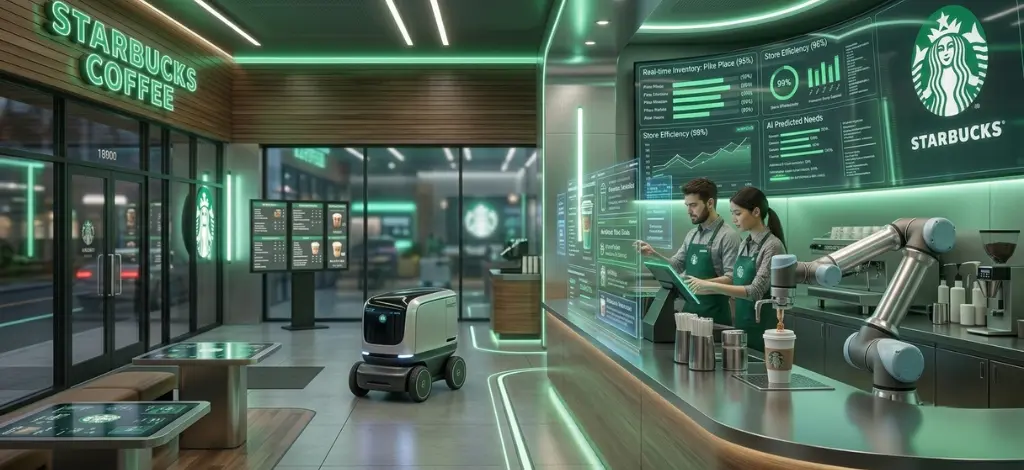
Starbucks is no longer just a coffee company serving drinks; it is rapidly becoming a technology‑driven organization that is rethinking how it runs its entire operation. Recent reports reveal that the company is actively developing its own artificial intelligence tools to replace some software it currently buys from major vendors like Microsoft and IBM, based on details from an internal presentation shared with media. This move might sound surprising at first, but when you look deeper, it actually makes strategic sense in the current enterprise landscape. Businesses today are under pressure to reduce costs, improve efficiency, and gain more control over their technology stack, and AI is making that possible like never before. Starbucks is simply stepping into a future where companies don’t just use software — they build it.
The big shift towards building in‑house technology
Starbucks’ approach reflects a broader shift where large enterprises are increasingly exploring in‑house, AI‑assisted development instead of relying solely on traditional software vendors. By using AI to help build and customize key systems, Starbucks aims to tailor its tools to the specific needs of its stores, supply chain, and workforce. This marks an evolution from being primarily a consumer brand to being a company where technology engineering is central to how the business operates day‑to‑day.
Why software costs are forcing change
One of the biggest reasons behind this transformation is cost. According to figures shared internally and reported by several outlets, Starbucks spends about 400 million dollars every year on software, which is a massive amount even for a global brand. When a company sees such a large recurring expense, it naturally starts asking whether there is a smarter way to manage it. By developing its own tools, Starbucks hopes over time to reduce licensing fees and limit dependence on expensive external vendors, even if in‑house development requires upfront investment. It’s similar to switching from renting to owning; the initial effort might be higher, but the long‑term benefits in control and cost optimization can be significant.
The role of the 2 billion dollar cost‑cutting plan
This initiative is not happening in isolation but is part of a broader strategy to cut roughly 2 billion dollars in costs across the business. Starbucks is reviewing contracts and services related to technology to find areas where savings can be achieved without compromising operations. Instead of simply cutting tools, the company is looking to replace some of them with smarter, AI‑powered alternatives that can perform the same tasks more efficiently and with more customization. This shows a shift in mindset where cost‑cutting is not just about trimming budgets, but about transforming how work is done through better technology.
What systems Starbucks is planning to replace
The company is specifically targeting two major systems as part of this transformation. One is a Microsoft‑based system used for inventory tracking, reported as part of the Dynamics 365 suite. The other is an IBM tool that manages maintenance operations, identified in coverage as IBM TRIRIGA in Starbucks’ internal tech stack. These systems are critical to daily store operations, meaning Starbucks is taking a bold step by attempting to replace them with in‑house software. It highlights how confident the company is becoming in its ability to build reliable alternatives using artificial intelligence and internal engineering teams.
Understanding the importance of inventory management
Inventory management is the backbone of any retail business, especially one like Starbucks that deals with thousands of products across global locations. From coffee beans to milk, syrups, and food items, everything needs to be tracked accurately to avoid shortages, waste, and stock imbalances. By building its own AI‑powered inventory system, Starbucks aims to create a more tailored solution that fits its unique demand patterns, store formats, and supply chain workflows, instead of relying on generic third‑party software that can require heavy customization. The goal is to improve visibility across stores while responding more quickly to changing customer behavior and local trends.
Maintenance systems and operational efficiency
Maintenance management might not sound exciting, but it plays a crucial role in ensuring that equipment runs smoothly across all stores. From espresso machines to refrigeration units and ovens, any failure can directly impact customer experience and sales. The IBM system currently handles many of these maintenance workflows, but Starbucks believes it can build a more efficient and customized solution internally. With AI, maintenance can become more predictive rather than purely reactive, meaning issues could be detected and addressed before they cause downtime. This type of predictive maintenance is important for a company operating thousands of stores with complex equipment environments.
How artificial intelligence is enabling this transformation
Artificial intelligence is the key enabler behind this entire strategy. In the past, building such complex systems would have required years of development and very large software teams. Today, AI‑assisted coding tools and modern cloud platforms are accelerating the process significantly. Developers can now use AI to generate code, test logic, and optimize performance much faster than traditional manual approaches. This reduces development time and can help lower costs, making it more feasible for companies like Starbucks to build their own enterprise‑grade software instead of relying entirely on external providers.
AI‑assisted coding and faster development cycles
AI‑assisted coding is changing the way software is created inside large organizations. Instead of writing every line of code manually, engineers can use AI tools to scaffold modules, suggest fixes, and automate repetitive tasks in the development lifecycle. This not only speeds up development but can also reduce certain categories of human error, especially in boilerplate or routine code. Starbucks is leveraging these technologies to build platforms that can replace existing tools, showing how AI has moved from being just a productivity booster to becoming a strategic asset in enterprise software development.
Expected timeline for launching these tools
According to reporting based on Starbucks’ internal presentation, some of the internally developed tools could roll out by the end of next year, depending on testing results and performance in pilots. This timeline indicates that the company is moving quickly but still cautiously, recognizing that these systems are critical to global operations. Building and deploying software that supports thousands of stores worldwide is not a simple task, and thorough testing is essential to ensure reliability and resilience. Starbucks appears to be balancing speed with quality, which is crucial for long‑term success and for maintaining store‑level trust in new tools.
Encouraging employees to adopt AI
Starbucks is not just using AI at the organizational and infrastructure level; it is also encouraging employees and corporate staff to integrate AI tools into their daily work. The company has signaled that it wants a culture where experimentation with AI is supported and innovation around new workflows is rewarded. While public reporting does not provide exhaustive detail on how performance evaluations and bonuses are structured around AI usage, it does indicate that leadership is pushing for wider adoption of AI‑driven tools across the organization. This helps build a workforce that is comfortable with new technology as Starbucks’ systems evolve.
A broader trend across industries
Starbucks is not alone in this approach. Across industries, companies are increasingly using AI to build custom solutions and reduce reliance on traditional software vendors, especially when core processes are seen as strategically important. For years, businesses were locked into long‑term contracts with tech giants because building alternatives was too complex, costly, and risky. Now, AI‑assisted development, cloud infrastructure, and modular architectures are lowering those barriers and giving companies the confidence to take more control over their technology. Starbucks’ strategy fits into this larger movement, and it is drawing attention because of the brand’s scale and visibility.
Impact on major technology vendors
This shift could have significant implications for companies like Microsoft and IBM, which have long supplied enterprise applications to global brands. If more businesses start building their own tools, the demand growth for some categories of enterprise software subscriptions could slow or change shape. Reports have already highlighted that investor concerns about this trend, including Starbucks’ move, have contributed to pressure on software stocks such as Microsoft, IBM, Salesforce and Oracle after the news broke. This illustrates how disruptive AI‑driven in‑house development can be, not just for startups but also for established industry leaders whose revenue depends on recurring licenses.
Comparing in‑house software and third‑party tools
There are clear advantages and disadvantages to building software internally. On one hand, companies gain full control over features, better customization for their own workflows, and potential cost savings over the long term if systems are managed efficiently. On the other hand, they take on the responsibility of maintenance, security, updates, and long‑term development roadmaps, which requires sustained investment in talent and infrastructure. Starbucks is betting that the benefits of control, flexibility, and strategic alignment will outweigh the challenges, but it is not a decision without risks and ongoing obligations.
Budget cuts and restructuring efforts
As part of its transformation, Starbucks is also restructuring aspects of its technology operations. The company has indicated plans to reduce its technology and software budget, including cutting some external software spending and lessening reliance on contractors, as part of the wider cost‑cutting program. By bringing more work in‑house, Starbucks hopes to build stronger internal capabilities that can deliver long‑term value while keeping overall costs in check. This aligns with its decision to invest in engineering teams and AI‑assisted development rather than simply renewing existing contracts.
Expansion of global tech teams
To support this shift, Starbucks is expanding and redistributing its technology workforce by establishing offices in new locations such as Nashville and India, alongside its Seattle headquarters. These hubs allow the company to access a broader and more diverse talent pool, including engineers and data specialists who can work on AI‑driven platforms and internal tools. The result is a distributed but connected tech ecosystem that can develop and maintain the company’s growing portfolio of in‑house software.
Job cuts and organizational changes
The transformation has also involved difficult decisions, including job reductions and organizational changes in technology and other areas as Starbucks reshapes its operating model. Reports point to layoffs as part of the broader restructuring and cost‑cutting initiatives, though specific numbers tied directly to the AI software program are not uniformly detailed in public summaries. This underscores a central tension: while automation and AI can improve efficiency and reduce certain costs, they also raise concerns about job security and how workforce transitions are managed.
Challenges faced with AI implementation
Despite its ambitious plans, Starbucks has faced challenges with AI in the past. Reporting mentions that not all AI‑driven inventory and operational experiments have delivered the desired results, highlighting that AI is not a guaranteed quick fix. This history shows that successful implementation requires careful planning, testing, and iteration, especially when new systems affect thousands of stores and employees. Starbucks’ current strategy appears to factor in these lessons by emphasizing staged rollouts and extensive testing for new in‑house tools.
Human and AI collaboration in the workplace
Starbucks has made it clear that its goal is not to simply replace human workers with algorithms, but to support them with better tools. AI systems are being designed to assist employees by simplifying tasks, improving access to information, and helping manage operational complexity. For example, AI can help staff quickly find procedures, track store‑level performance, or troubleshoot equipment issues, allowing frontline teams to focus more on customer experience and quality. This approach highlights the importance of combining human skills with technological capabilities rather than treating them as opposites.
What this means for other businesses
The strategy adopted by Starbucks could serve as a reference point for other companies looking to reduce costs and improve efficiency without losing control of critical operations. By leveraging AI, businesses can build customized solutions that better match their processes and culture, especially in areas like inventory, maintenance, and customer interaction. However, it is important for organizations to carefully evaluate the risks and ensure they have the necessary engineering skills, governance, and security practices to manage in‑house development at scale. Not every company will want or need to replace major vendor systems, but many may explore hybrid models inspired by moves like Starbucks’.
The future of enterprise software
The rise of AI‑driven development is likely to reshape the enterprise software industry over the coming years. As more companies build or heavily customize their own tools, traditional vendors may need to adapt their business models with more flexible pricing, modular offerings, and deeper integration options. This could lead to more competition, new forms of partnership, and a shift in how value is delivered and measured in the software market. The landscape is evolving rapidly, and vendors that fail to innovate around AI and in‑house collaboration could find it harder to maintain their position.
Risks of relying on internal development
While building in‑house software offers many benefits, it also comes with risks that businesses must manage. Maintenance costs, security responsibilities, technical debt, and the need for continuous updates can add up over time if not handled properly. Companies must be prepared to invest consistently in skilled teams, documentation, and infrastructure to ensure long‑term success. Starbucks will need to carefully balance its cost‑cutting goals with the reality that running mission‑critical software internally is an ongoing commitment, not a one‑off project.
Starbucks’ long‑term vision with AI
Looking ahead, Starbucks is likely to expand its use of AI beyond inventory and maintenance systems into more areas of its operations. The company has already explored applications in customer service, store operations, point‑of‑sale systems, and decision‑making. As technology continues to evolve, AI could become even more central to how Starbucks manages its supply chain, personalizes customer experiences, and supports its global workforce. The current initiative to replace Microsoft and IBM tools is a significant step in that direction.
Key insights from Starbucks’ AI strategy
There are several important lessons to take from this move. First, AI is no longer just a tool for innovation; it is increasingly a driver of cost efficiency and strategic control over critical systems. Second, companies are more willing than before to challenge traditional vendor relationships when they see a path to building or co‑creating alternatives. Finally, success with AI requires a combination of technology, strategy, and culture — the right tools, the right business goals, and a workforce ready to adopt new ways of working. Starbucks is attempting to align all three, which is why its approach is gaining attention across the technology and business communities.
Conclusion
Starbucks is taking a bold step by using artificial intelligence to build its own software and reduce reliance on major technology vendors like Microsoft and IBM. This move reflects a broader shift in how businesses approach technology, focusing on control, efficiency, and innovation rather than simply renewing legacy contracts. While challenges remain, the potential benefits for Starbucks are significant, and the company’s strategy is likely to influence how other enterprises think about AI and in‑house development. As AI continues to evolve, it will likely play an even bigger role in shaping the future of business operations and enterprise software.
FAQs
What is Starbucks trying to achieve with AI tools?
Starbucks aims to reduce software costs, improve efficiency, and gain more control over critical systems by building its own AI‑powered tools instead of relying solely on third‑party vendors.
Which software systems is Starbucks replacing?
The company is working on alternatives to a Microsoft inventory‑tracking system, associated with Dynamics 365, and an IBM maintenance management tool, reported as IBM TRIRIGA.
How much does Starbucks spend on software annually?
Starbucks spends approximately 400 million dollars each year on software, according to figures shared internally and reported by financial and technology media.
Will AI replace employees at Starbucks?
The company has stated that AI is intended to support employees and improve operations rather than directly replace store‑level staff, even as it pursues broader efficiency and restructuring efforts.
When will these AI tools be launched?
Some of the internally developed tools could be rolled out by the end of next year, depending on testing, performance, and how they scale across Starbucks’ global operations.
Ready to build smarter, scalable technology for your business? Talk to the experts at Alitech at [email protected]
Ready to grow as a freelancer? Join Realancer to find quality projects and clients who value your expertise—sign up now for free at https://realancer.net

Zeeshan Ali Shah is a professional blog writer at AliTech Solutions, and Realancer renowned for crafting engaging and informative content. He holds a degree from the University of Sindh, where he honed his expertise in technology. With a keen eye for detail and a passion for staying up-to-date on the latest tech trends, Zeeshan’s writing provides valuable insights to his readers. His expertise in the tech industry makes him a sought-after writer, and his work at AliTech Solutions has earned him a reputation as a trusted and knowledgeable voice in the field.


Leave a Reply