


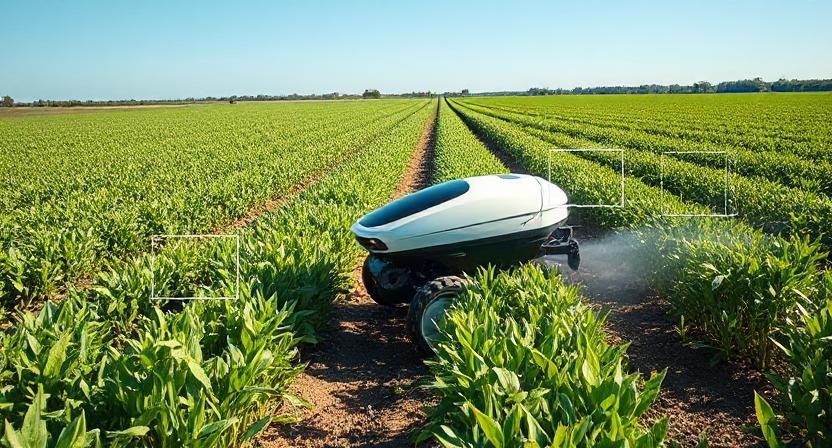
In the era of smart agriculture, cutting-edge technologies are reshaping how we grow food. A breakthrough invention emerging in 2025 is the AI‑powered smart farming robot designed to automate key farming tasks efficiently, sustainably, and at reduced cost. Developed by an innovative startup in India, this robot leverages artificial intelligence, robotics, and computer vision to handle planting, weeding, and crop monitoring autonomously in fields. The AI‑powered smart farming robot is becoming a game‑changer for small farms, providing precision agriculture tools once only available to large agribusinesses.
What Is the AI‑Powered Smart Farming Robot?
The AI‑powered smart farming robot is a semi-autonomous ground-based machine equipped with sensors, cameras, and AI algorithms. It navigates between crop rows, identifies weeds and plant health issues, and performs targeted actions such as weeding, planting, or applying nutrients. The robot’s modular attachments allow it to adapt to different crop types and tasks. Its onboard AI model uses computer vision to distinguish between crop and weed plants, optimizing resource usage and minimizing chemical fertilizer or pesticide application.
Who Developed the Robot and Why It Matters
The innovation comes from an agritech startup incubated at the ELCIA Tech Summit 2025 in India’s Electronics City, Bengaluru. At this prestigious event, themed “Humans, Machines and Meaning 2.0,” emerging startups showcased breakthrough automation tools for agriculture and industry advancement. The team behind the robot won accolades for deep-tech innovation by fusing AI, robotics, and IoT to empower farmers with accessible automation. Their prototype gained recognition for its ability to reduce labor costs by up to 40% while maintaining yield levels on par with mixed‑use farms.
How the AI‑Powered Smart Farming Robot Operates
Robot Navigation and Visual Detection
Using GPS, ultrasonic sensors, and LiDAR, the AI‑powered smart farming robot navigates rows of planted crops with high accuracy, adjusting speed and direction to avoid obstacles. Its onboard camera system continuously captures imagery of plants while an onboard GPU processes computer vision AI models in real-time to detect weeds, pests, and signs of disease.
Targeted Weeding and Fertilizer Application
Once the AI identifies weed patches or nutrient deficiencies, the robot uses precise mechanical arms or sprayer attachments to remove weeds or apply small doses of fertilizer or pesticides. This targeted approach significantly reduces chemical use compared to blanket spraying methods.
Data Aggregation and Analytics
All operational data—plant health, weed density, soil moisture—is collected and stored in the robot’s cloud-connected dashboard. Farmers can access insights via a mobile or web app, and the platform provides recommendations for irrigation schedules, planting strategies, and yield forecasting.
Benefits of the AI‑Powered Smart Farming Robot
Sustainable and Eco-Friendly Farming
By reducing chemical inputs and targeting only affected areas, the AI‑powered smart farming robot promotes sustainable agriculture and lowers environmental impact. Reduced runoff of fertilizers and herbicides preserves soil and nearby ecosystems.
Cost Efficiency for Small and Medium Farms
Labor shortages and high wages have been major constraints for small-scale farms. The robot automates repetitive and physically demanding tasks, enabling smaller farms to maintain productivity while reducing operational costs.
Precision and Yield Optimization
With AI-driven weed detection and nutrient monitoring, crops grow under near-ideal conditions. This precision leads to higher yields and more consistent quality, enabling farms to be competitive and profitable.
Scalability and Modularity
The robot’s modular design lets farmers customize attachments for planting, spraying, or harvesting specific crops. This flexibility makes it suitable for various farm sizes and crop types—from tomatoes to cereals.
Challenges and Current Limitations
High Initial Equipment Cost
Although labor-saving over time, the upfront cost of the AI‑powered smart farming robot may be high for resource-limited farmers. Subsidies or leasing models are being explored to increase accessibility.
Technical Reliability and Maintenance
Farm robots must endure rough terrain, variable weather conditions, and power constraints. Ensuring reliability and long-term maintenance support are necessities before large-scale adoption.
Connectivity and Infrastructure
In remote regions, poor network connectivity can hinder cloud data access and AI model updates. Offline AI processing and local storage can mitigate these issues, but reliable internet remains important.
Training and Adoption
Farmers need training to effectively operate the robot and interpret data dashboards. Bridging technology literacy gaps is essential for long-term success in adoption.
Timeline and Future Prospects
Following its showcase at ELCIA Tech Summit 2025, the startup plans pilot deployments later this year on farms in southern India. They aim to refine field performance, adapt attachments for additional crops, and roll out affordable leasing plans by early 2026. Partnerships are underway with regional agricultural cooperatives and government agencies to scale smart farming across South Asia and Africa. As AI robotics mature, similar AI‑powered smart farming robots could become standard tools to meet global food security goals.
AI‑Powered Smart Farming Robot: A Major Tech Trend of 2025
The AI‑powered smart farming robot encapsulates multiple trends shaping 2025 technological innovation. Robotics and AI are merging with agriculture to form precision farming systems. According to recent trend reports, agentic AI and autonomous systems are accelerating in enterprise applications, and agriculture is becoming a leading sector for real-world deployment. New human‑machine collaboration models and application-specific semiconductors are enabling robots to operate efficiently in field environments. This invention aligns with key themes from sources like McKinsey and the World Economic Forum highlighting responsible AI and autonomous systems reshaping industry practices.
Frequently Asked Questions (FAQs)
1. What is an AI‑powered smart farming robot?
An AI‑powered smart farming robot is an autonomous machine that uses AI for crop detection, navigation systems for field movement, and modular tools to perform tasks like weeding or targeted fertilizer spraying.
2. Who created this smart farming robot?
A startup featured at the 2025 ELCIA Tech Summit in India developed the robot, combining AI, robotics, and IoT for precision agriculture—earning recognition at the summit.
3. How does the robot detect weeds and pests?
The robot uses onboard computer vision cameras and AI algorithms to analyze plant images in real time, distinguishing between crops and weeds or identifying early signs of pests or disease.
4. What are the advantages of using this robot on farms?
The robot improves sustainability by reducing chemical usage, lowers labor costs, enhances yield, and delivers scalable automation for small and mid-sized farms.
5. When is this technology expected to be widely adopted?
Pilot deployments are planned for late 2025, with broader availability and leasing models expected in 2026 across Asia and Africa, if trials are successful.
Read more blogs: Alitech.io
Realancer is a flexible freelancing platform built of real life. Whether you want to work part-time , weekend , or just when you are free , Realancer lets you offer locally or remotely – on your own terms. Fair flexible and built for freelancers and clients alike.
Join the waiting list now: https://app.realancer.net/



Leave a Reply