


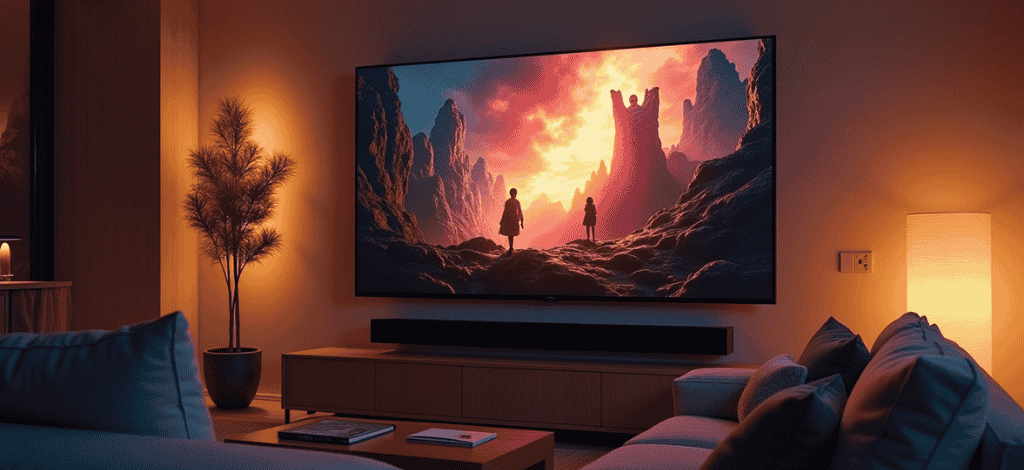
The Growing Obsession with Ultra-HD TVs
Walk into any electronics store today, and you’ll see 4K and 8K TVs proudly displayed with flashy marketing promises. The average consumer believes that more pixels mean better picture quality, leading many to upgrade their televisions in pursuit of a “cinematic” experience. But new research from the University of Cambridge and Meta suggests that for most living rooms, ultra-HD TVs may not deliver a noticeable improvement over cheaper, lower-resolution screens.
The Surprising Findings from Cambridge and Meta
Researchers from the University of Cambridge, in collaboration with Meta, have discovered that the human eye may not be able to detect the difference between a 4K, 8K, and 2K display at typical viewing distances. The study revealed that the average viewer sitting about 2.5 meters (8.2 feet) from a 44-inch TV cannot see any visual benefit from ultra-high-definition screens compared to a Quad HD (QHD) screen of the same size.
Understanding the “Resolution Limit” of the Human Eye
The concept at the heart of this research is known as the “resolution limit.” Simply put, it’s the maximum number of pixels per degree (PPD) that the human eye can distinguish. While 20/20 vision is typically said to perceive 60 PPD, the Cambridge team found that most people can actually see slightly more—up to around 94 PPD for grayscale images and 89 PPD for red and green patterns. Beyond that, extra pixels don’t enhance clarity because your eyes physically can’t process the detail.
How the Experiment Was Conducted
The researchers conducted a detailed experiment using a 27-inch 4K monitor that could slide closer or further from the participants. Eighteen volunteers with normal or corrected vision viewed sets of images containing fine patterns in different colors. When the lines became too small to detect, the team determined that the image had reached the eye’s resolution limit. They later confirmed these findings with text-based tests to ensure accuracy.
What the Numbers Really Mean
For an average viewer in a typical living room, these results mean that upgrading from a 4K to an 8K screen is practically pointless unless you plan to sit extremely close to your TV. Even a high-quality 2K or QHD display already exceeds what the eye can discern at common viewing distances. As Dr. Maliha Ashraf from Cambridge put it, “At a certain distance, adding more pixels becomes wasteful because your eye can’t detect them.”
The Online Calculator That Reveals Your True TV Needs
To make their findings practical, the research team created a free online calculator. Users can input their screen size and viewing distance to determine whether a higher-resolution TV would make any visible difference. For most setups, the calculator shows that a 4K TV already reaches or exceeds the visual limit of the human eye.
The Myth of “More Pixels = Better Quality”
For years, TV manufacturers have marketed higher resolution as the ultimate measure of screen quality. While more pixels technically mean finer detail, this study shows that beyond a certain point, resolution no longer affects what you see. Instead, your money might be better spent on other display features like contrast, brightness, and color depth.
Why Contrast Matters More Than Resolution
Experts agree that contrast ratio and HDR (High Dynamic Range) technology play a bigger role in image quality than raw pixel count. A mid-range 4K OLED TV with strong contrast and color accuracy will deliver a more immersive experience than a low-end 8K display. The number of pixels doesn’t matter if the blacks aren’t deep or the highlights aren’t bright.
The Real-World Impact on Consumers
For everyday consumers, this research offers some financial relief. It means you don’t need to splurge on an expensive 8K TV to enjoy stunning visuals. If your current 4K television is working fine, upgrading will likely make no difference in your viewing experience. You can invest that money in a better sound system or smart lighting setup instead.
The Environmental and Economic Implications
Beyond cost, there’s also an environmental angle. Higher-resolution TVs consume more energy and require more processing power. They also increase manufacturing complexity and electronic waste. By sticking to displays that match the human eye’s realistic limits, consumers can help reduce unnecessary energy use and environmental impact.
The Science Behind Pixels Per Degree (PPD)
Pixels per degree is a way to measure how many pixels you can see within one degree of your field of vision. The higher the PPD, the sharper the image appears—up to a point. Once the PPD surpasses the human eye’s resolution limit, extra pixels don’t improve sharpness. This is why sitting closer to a screen makes pixels more noticeable, while sitting farther away makes them indistinguishable.
How This Affects AR, VR, and Mobile Displays
While this study focused on TVs, it also has major implications for the design of mobile, VR, and AR displays. Engineers are pushing for higher pixel densities in these devices, but the research warns that going beyond human perception limits may be wasteful. Instead, companies should focus on improving color accuracy, motion smoothness, and visual comfort.
Expert Insights on the Future of Display Technology
Co-author Professor Rafał Mantiuk from Cambridge noted that more pixels mean more processing power and higher costs without real-world benefits. He explained, “We wanted to find the point where adding resolution stops making sense.” His team’s results may help manufacturers design more efficient displays that align with what people can actually see, rather than chasing marketing trends.
What Should You Focus on When Buying a TV?
Instead of obsessing over resolution, shoppers should focus on other aspects that truly affect the viewing experience:
-
Panel Type: OLED and QLED screens offer better contrast.
-
HDR Support: Enhances brightness and color range.
-
Refresh Rate: Improves motion clarity, especially for gaming.
-
Color Accuracy: Ensures lifelike visuals.
-
Audio Quality: Completes the cinematic experience.
When these features are balanced, even a 2K or 4K TV can outperform an 8K display in visual satisfaction.
Why This Study May Change How We Buy TVs
This groundbreaking research could reshape consumer expectations and influence the marketing strategies of major TV brands. If people realize that they can’t see the difference between 4K and 8K in normal conditions, the industry may pivot toward enhancing display performance in other ways—such as improved contrast, better motion handling, and AI-based upscaling.
The Final Verdict: Is Ultra-HD Worth It?
For most people, no. Unless you sit very close to a massive screen, you won’t notice the difference between 4K and 8K resolution. The human eye simply can’t process that level of detail from typical distances. In short, a well-calibrated 4K TV is more than enough for a crisp, realistic picture. Don’t let marketing hype convince you otherwise.
Conclusion
The University of Cambridge and Meta study sheds light on something many tech enthusiasts suspected: more pixels don’t always mean better visuals. Human vision has natural limits, and once those are reached, resolution improvements are wasted. The next time you’re tempted to upgrade your TV, remember—clarity isn’t just about pixel count. Focus on what really enhances your viewing experience: contrast, color, and content quality.
FAQs
1. Does 8K resolution look better than 4K in any situation?
Yes, but only if you’re sitting very close to a very large screen. For typical living rooms, your eyes won’t detect the difference.
2. Should I upgrade from a 4K TV to an 8K TV?
Not unless your setup involves a massive screen and short viewing distance. Most people won’t see any improvement.
3. What’s more important than resolution when buying a TV?
Focus on contrast, color accuracy, HDR performance, and refresh rate—these impact picture quality far more than pixel count.
4. Do higher-resolution TVs consume more power?
Yes. More pixels require more processing power and energy, making ultra-HD TVs less efficient.
5. How can I check if my TV’s resolution matches my needs?
Use the free online calculator created by the Cambridge team to enter your viewing distance and screen size—it will show whether your screen already exceeds your eye’s resolution limit.
Join Realancer — where real talent meets real opportunity.
Built for freelancers who value fairness, freedom, and growth, Realancer empowers you to work smarter, earn better, and build your future on your own terms.
Join the waitlist now: https://app.realancer.net/
Read more blogs: Alitech Blog

Zeeshan Ali Shah is a professional blog writer at AliTech Solutions, and Realancer renowned for crafting engaging and informative content. He holds a degree from the University of Sindh, where he honed his expertise in technology. With a keen eye for detail and a passion for staying up-to-date on the latest tech trends, Zeeshan’s writing provides valuable insights to his readers. His expertise in the tech industry makes him a sought-after writer, and his work at AliTech Solutions has earned him a reputation as a trusted and knowledgeable voice in the field.



Leave a Reply