


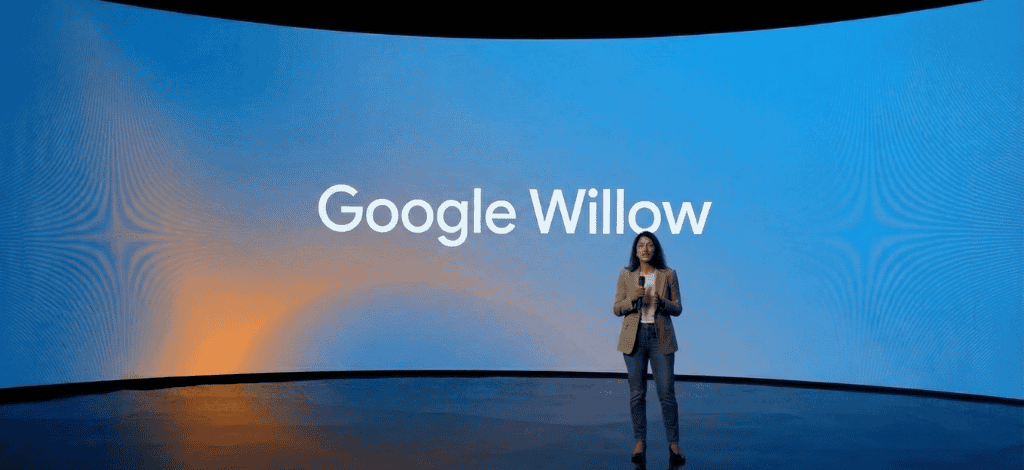
A quiet revolution inside Google’s secret lab
Hidden behind high-security doors in Santa Barbara, California, Google is running one of the most important technology experiments of our time. This is not a flashy consumer gadget or a new phone. It is Willow, a quantum computer that could quietly decide who leads the world economy for decades to come.
Why Willow matters more than any computer before it
Willow is not just faster than traditional computers. It can solve problems that normal machines simply cannot solve at all. This changes everything, from how medicines are discovered to how financial systems stay secure.
First impression
If you expect glowing screens and futuristic interfaces, you will be surprised. Willow does not look like a supercomputer from a movie. It looks more like a golden chandelier hanging in midair, silent and almost mysterious.
What Willow actually looks like in real life
The system is roughly the size of an oil barrel, made of stacked circular plates connected by hundreds of black wires. These wires descend into a bronze refrigerator filled with liquid helium. The entire structure feels strangely retro, almost like something built in the 1980s.
The coldest place in the known universe
At Willow’s core is a quantum chip operating at temperatures just a fraction above absolute zero. This extreme cold is necessary because quantum bits, or qubits, are incredibly sensitive and fragile.
Meet Hartmut Neven and Google’s Quantum AI vision
Hartmut Neven, Google’s Quantum AI chief, leads this effort. He is known for blending deep physics knowledge with bold imagination. His mission is simple but ambitious: turn quantum theory into machines that solve problems humans currently cannot.
Why quantum computing changes the rules of technology
Traditional computers work step by step. Quantum computers work in parallel. This difference is like comparing someone checking doors one by one to someone opening every door at the same time.
Understanding qubits in simple words
Normal computers use bits that are either zero or one. Qubits can be zero, one, or both at the same time. This ability, called superposition, gives quantum computers massive power.
Willow’s 105 qubits and why that number matters
Willow contains 105 qubits, which may sound small compared to billions of transistors in modern chips. But in quantum terms, this allows Willow to process more combinations at once than there are atoms in the universe.
The problem Willow solved that classical computers can’t
Willow solved a benchmark problem in minutes that would take the world’s fastest classical computer more than 10 septillion years. That number is so large it exceeds the age of the universe.
Error correction: the biggest breakthrough with Willow
Quantum computers make mistakes easily. Willow proved, for the first time, that repeated error correction actually improves performance. This solved one of the biggest roadblocks in quantum computing.
From theory to reality: why this is a turning point
For years, critics said quantum advantage was just theory. Willow ended that debate by showing repeatable, real-world results that classical machines cannot match.
Real-world uses: medicine, energy, food, and climate
Willow can simulate molecules, helping scientists design better drugs faster. It can optimize energy grids, improve food production, and model climate systems with far greater accuracy.
Quantum computing and the future of artificial intelligence
Some experts believe true artificial intelligence may only be possible with quantum computing. The ability to explore massive solution spaces could unlock entirely new forms of learning.
The threat to Bitcoin and digital security
Quantum computers could eventually break today’s encryption. This means cryptocurrencies and secure communications will need new quantum-safe protections sooner than many expect.
Harvest now, decrypt later: why governments are watching
Intelligence agencies are believed to be storing encrypted data today, waiting for future quantum machines to decrypt it. Willow makes that future feel much closer.
The global quantum race between the US, China, and others
Quantum computing has become a geopolitical race. Whoever leads will gain enormous economic and military advantages.
China’s quantum strategy and the Zuchongzhi comparison
China has invested billions into quantum research and built its own powerful systems like Zuchongzhi 3.0. Unlike the US, China centralizes its efforts under state control.
The UK’s role in the quantum future
The UK is a historic leader in quantum science and plans major investments. There is hope it can become the third global power in this critical technology.
Will quantum computers replace classical computers?
No. Quantum computers will work alongside classical systems, handling problems that traditional machines cannot manage efficiently.
Why quantum machines won’t fit in your pocket
Quantum systems require extreme cooling and stability. They will live in specialized labs, not in phones or laptops.
Parallel universes and the multiverse debate
Some scientists suggest quantum speed hints at parallel realities. While unproven, Willow has reignited serious debate about the nature of reality itself.
Why Willow feels like science fiction becoming real
What once sounded like fantasy is now being measured, tested, and improved in real laboratories with real consequences.
What the next 25 years of technology may look like
Just as the internet and AI defined the early 21st century, quantum computing may define the next era of human progress.
Final thoughts on Willow and the quantum era
Willow is more than a machine. It is a signal that a new technological age has begun, one that will reshape science, security, and society in ways we are only beginning to understand.
Conclusion
Google’s Willow marks a historic moment in computing. It proves that quantum machines are no longer just experimental ideas but powerful tools capable of transforming the world. From medicine and climate science to cybersecurity and global power dynamics, Willow opens the door to a future where the impossible becomes possible. The quantum era is no longer coming. It has already begun.
FAQs
1. What makes Google Willow different from normal computers?
Willow uses quantum qubits instead of traditional bits, allowing it to solve certain problems exponentially faster.
2. Can Willow break Bitcoin encryption today?
Not yet, but it signals that future quantum computers may pose serious challenges to current cryptographic systems.
3. Why does Willow need extreme cooling?
Qubits are highly sensitive to heat and noise, so near-absolute-zero temperatures are required for stability.
4. Will quantum computers replace laptops and phones?
No, they will work alongside classical computers for specialized tasks.
5. Is it available for public use?
Currently, Willow is a research system used by Google’s Quantum AI lab, not a consumer product.
Read more blogs: Alitech Blog
Tired of platforms that make you pay just to apply for jobs?
Sign up now on Realancer – Free Freelancing Always!
👉 Join the waitlist now: https://realancer.net

Zeeshan Ali Shah is a professional blog writer at AliTech Solutions, and Realancer renowned for crafting engaging and informative content. He holds a degree from the University of Sindh, where he honed his expertise in technology. With a keen eye for detail and a passion for staying up-to-date on the latest tech trends, Zeeshan’s writing provides valuable insights to his readers. His expertise in the tech industry makes him a sought-after writer, and his work at AliTech Solutions has earned him a reputation as a trusted and knowledgeable voice in the field.


Leave a Reply