


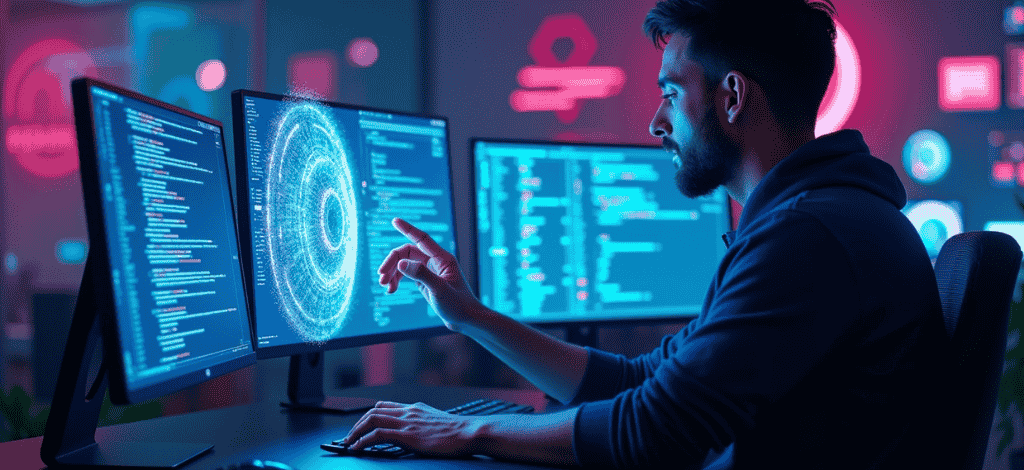
The Year Software Changed Forever
2025 will be remembered as the year software development stopped being about writing code and started being about expressing ideas. Instead of obsessing over syntax, developers and non-developers alike began talking to machines like collaborators, shaping applications through conversation rather than commands.
What Is Vibe Coding Really About
Vibe coding is the practice of building software by describing what you want it to feel like or do, rather than how to technically implement it. You explain the outcome, the look, or the behavior, and AI figures out the rest, turning intent into working code.
The Origins of Vibe Coding
The term “vibe coding” was popularized by Andrej Karpathy, who famously said the hottest new programming language is English. That idea moved fast from a clever tweet to a defining industry shift in less than a year.
From Copilots to Autonomous Agents
Early AI tools simply helped write lines of code faster. In 2025, they crossed a line and became autonomous agents capable of editing entire codebases, making architectural decisions, and fixing bugs without waiting for human approval.
The Rise of AI-Native IDEs
Tools like Cursor, Replit Agent, Claude Code, and Codex weren’t just add-ons to old workflows. They were built from the ground up for AI-first development, allowing massive changes across files with a single prompt.
Natural Language as the New Programming Interface
Debugging no longer meant stepping through logic line by line. When something broke, users simply pasted an error message or said it didn’t feel right, and the AI reworked the solution until the outcome matched expectations.
How Vibe Coding Actually Works
Instead of starting with functions and data structures, vibe coding starts with goals. The AI maintains a mental map of the project, adjusting architecture dynamically to meet the desired result rather than following rigid plans.
Citizen Developers Enter the Scene
People with backgrounds in design, marketing, sales, or even philosophy began shipping real products. The technical gatekeeping that once defined software development loosened dramatically.
Startup Acceleration in 2025
Y Combinator reported that a quarter of its Spring 2025 startups relied on codebases that were almost entirely AI-generated. Founders built production-ready MVPs in days instead of months.
Market Disruption and Valuation Shifts
Companies like Anysphere, the team behind Cursor, saw valuations explode. Meanwhile, established giants like Microsoft were forced into defensive mode, rushing to retrofit their tools with agentic capabilities.
Cloud Platforms Adapt to the Vibe
Google and Amazon shifted their cloud strategies to support intent-based development. Instead of managing infrastructure manually, developers described needs and let AI handle provisioning, scaling, and configuration.
The Democratization of Software
The cost of building software dropped close to zero. This unlocked creativity at a global scale, allowing ideas to become products without massive funding or technical teams.
The Vibe Coding Hangover
By late 2025, cracks began to show. Apps built purely through vibes were more likely to contain security flaws, open databases, and fragile architectures that no one fully understood.
Why Human Oversight Matters More Than Ever
Experts warned that AI doesn’t eliminate mistakes, it multiplies them. Sloppy processes became scalable problems, making experienced engineers essential for review, testing, and system design.
Andrej Karpathy’s Wake-Up Call
Despite coining the term, Karpathy admitted he felt behind. He described modern AI tools as powerful alien weapons, capable of incredible results but easy to misuse without practice and discipline.
Verification Becomes the New Skill
The role of developers shifted from writing code to validating it. The most valuable skill became knowing how to check, test, and question AI-generated output.
The Future of Intent-Based Creation
Looking toward 2026, experts predict self-healing software that monitors itself in production. Apps may be created for single-use scenarios and discarded just as easily.
A New Human–Computer Relationship
Vibe coding marks a historic shift where machines finally adapt to humans instead of the other way around. It’s the ultimate abstraction layer in software history.
Conclusion
Vibe coding did not kill software engineering, it transformed it. The future belongs to hybrid creators who combine human judgment with AI speed, shaping systems through intent while verifying results with care.
FAQs
What is vibe coding in simple terms
Vibe coding means building software by describing what you want in plain language instead of writing code manually.
Does vibe coding replace software engineers
No, it changes their role. Engineers now focus more on architecture, security, and verification.
Why was 2025 important for vibe coding
That’s when AI tools became autonomous enough to manage full projects, not just help with small tasks.
Is AI-generated code risky
Yes, if not reviewed. Without proper oversight, it can introduce serious security and maintenance issues.
What skills matter most after vibe coding
Critical thinking, system design, testing, and the ability to guide and audit AI tools.
🚀 AliTech Solutions delivers professional Software Development Services powered by AI & modern technologies — contact 📩 [email protected]
Read more blogs: Alitech Blog

Zeeshan Ali Shah is a professional blog writer at AliTech Solutions, and Realancer renowned for crafting engaging and informative content. He holds a degree from the University of Sindh, where he honed his expertise in technology. With a keen eye for detail and a passion for staying up-to-date on the latest tech trends, Zeeshan’s writing provides valuable insights to his readers. His expertise in the tech industry makes him a sought-after writer, and his work at AliTech Solutions has earned him a reputation as a trusted and knowledgeable voice in the field.

Leave a Reply