


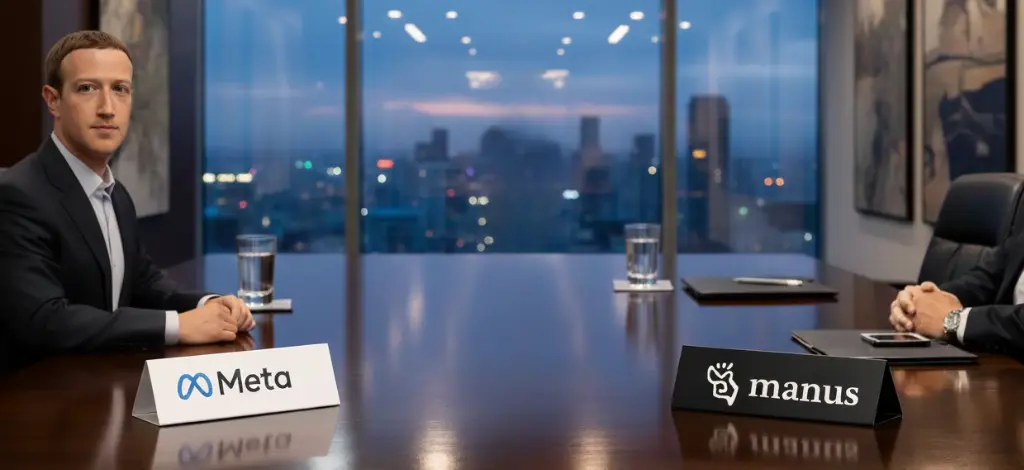
Why This Deal Matters in the Global AI Race
The acquisition of Manus by Meta for over $2 billion is more than just another tech headline. It signals how serious the global race for advanced artificial intelligence has become. Big tech companies are no longer only building AI in-house; they are buying speed, talent, and innovation wherever they can find it. This deal places Meta right in the middle of the competition with OpenAI, Google, and other AI leaders.
Overview of Manus as an AI Startup
Manus is a fast-growing artificial intelligence startup that focuses on building what it calls a general AI agent. Unlike traditional chatbots that wait for instructions, Manus aims to act independently. It can research, analyze, decide, and execute tasks with minimal human input, which makes it attractive to businesses and professionals.
The Meaning of a General AI Agent
A general AI agent is designed to behave more like a digital worker than a chatbot. Think of it as an assistant that does not just answer questions but completes full workflows. From analyzing stock data to screening resumes, Manus tries to handle tasks from start to finish, much like a human employee would.
How Manus First Entered the Spotlight
Manus went viral in early 2025 when it released a demo showing its AI agent completing complex tasks on its own. Social media quickly picked it up, and many started calling it the next big AI breakthrough from Asia. The buzz helped Manus gain users, investors, and global attention almost overnight.
What Exactly Does Manus Do?
Manus allows users to delegate work to an AI agent. The system can conduct market research, write code, analyze data, design slides, and even browse the web to complete tasks. Instead of giving step-by-step prompts, users define a goal, and Manus figures out how to achieve it.
Real-World Use Cases of the Manus AI Agent
Businesses use Manus for competitive research, financial analysis, and internal reporting. Recruiters rely on it for resume screening, while developers use it for debugging and code generation. Designers and marketers also use it to create presentations and digital assets faster than before.
Manus Revenue Growth and Business Model
Manus operates on a subscription-based model combined with usage-based pricing. In less than a year, the company crossed $100 million in annual recurring revenue. Including additional income streams, its total revenue run rate exceeded $125 million, which is impressive for such a young startup.
Funding History and Valuation Journey
Earlier in 2025, Manus raised $75 million in a funding round led by Benchmark. At the time, the company was valued at around $500 million. The Meta acquisition multiplied that valuation several times, landing Manus in the $2 billion to $3 billion range.
Who Founded Manus?
Manus was founded by a team of experienced Chinese tech entrepreneurs under the AI product studio Butterfly Effect. The founders brought deep expertise in consumer software, AI infrastructure, and global product development.
Xiao Hong’s Entrepreneurial Background
Xiao Hong, also known as Red in Chinese tech circles, is the founder and CEO of Manus. Born in 1992, he studied software engineering and launched his first startup shortly after graduating. Before Manus, he built productivity tools used by millions, which gave him valuable experience in scaling software products.
Ji Yichao and the Technical Vision Behind Manus
Ji Yichao, also known as Peak Ji, serves as the chief scientist behind Manus. He is responsible for the AI architecture and infrastructure. Ji became the public face of Manus during its launch and was later recognized by MIT Technology Review as one of the top innovators under 35.
Product Leadership and the Role of Zhang Tao
Zhang Tao leads product development at Manus. With prior experience at ByteDance and Tencent, he understands how to design products for global users. His role has been critical in making Manus user-friendly despite its complex underlying technology.
Why Meta Decided to Buy Manus
Meta wants to scale AI agents across its platforms quickly. Buying Manus gives Meta access to a ready-made general AI system, a proven revenue model, and a skilled team. Instead of starting from scratch, Meta accelerates its AI roadmap through acquisition.
How Meta Plans to Use Manus Technology
Meta plans to keep Manus operating as a standalone product while integrating its technology into Meta AI. This means users may soon see Manus-style agents inside Facebook, Instagram, WhatsApp, and Meta’s business tools.
Impact on Meta AI, WhatsApp, and Business Tools
The biggest opportunity lies in WhatsApp and small business tools. Meta sees AI agents helping businesses automate customer support, marketing, and internal operations. Manus fits perfectly into this vision by acting as a digital worker for businesses.
Competition with OpenAI, Google, and DeepSeek
Meta faces intense competition from OpenAI’s ChatGPT, Google’s Gemini, and China’s DeepSeek. Manus gives Meta a unique angle by focusing on agentic AI rather than conversational AI. This could help Meta differentiate its offerings in a crowded market.
China Ties and Political Scrutiny Explained
Because Manus was founded in China, it attracted political attention in the U.S. Lawmakers questioned whether American capital should support AI companies with Chinese roots, especially given rising geopolitical tensions.
Manus Moving from China to Singapore
To reduce regulatory risk, Manus moved its headquarters to Singapore in mid-2025. This move aligned the company with global business norms and made it more attractive to Western investors and partners like Meta.
Data Privacy, Security, and U.S. Regulations
Meta confirmed that after the acquisition, Manus would have no remaining Chinese ownership. Services in China will be shut down, and employees joining Meta will not access customer data. These steps aim to satisfy regulatory and security concerns.
What This Means for Manus Customers
For existing customers, Manus says nothing will change. The platform will continue operating, subscriptions will remain active, and the product roadmap will continue. In fact, Meta’s resources may help Manus improve stability and features.
What This Acquisition Signals for Asian AI Startups
This deal shows that Asian AI startups can compete globally and attract major buyers. It also highlights Singapore’s growing role as a neutral hub for AI companies navigating U.S.-China tensions.
Future of General AI Agents After This Deal
The success of Manus could push the industry toward agent-based AI systems. Instead of chatting with AI, users may soon manage fleets of AI agents working independently across tasks and platforms.
Risks and Challenges Ahead for Meta and Manus
Despite the excitement, challenges remain. AI hallucinations, regulatory pressure, and integration risks could slow progress. Meta will need to balance innovation with responsibility to make the acquisition successful.
Final Thoughts on the Meta–Manus Acquisition
Meta’s acquisition of Manus is a bold move that reflects the changing nature of AI competition. By betting on general AI agents, Meta is positioning itself for the next phase of artificial intelligence, where AI does not just respond but acts.
Conclusion
The Meta and Manus deal is a landmark moment in the AI industry. It combines Silicon Valley scale with Asian innovation and signals a future where AI agents play a central role in work and daily life. Whether this bet pays off will depend on execution, trust, and the ability to deliver real value at scale, but one thing is clear: the AI race just entered a new chapter.
FAQs
1. What is Manus AI?
Manus is an AI startup that builds general AI agents capable of completing tasks autonomously with minimal human input.
2. How much did Meta pay for Manus?
While exact terms were not disclosed, reports value the deal between $2 billion and $3 billion.
3. Will Manus continue operating independently?
Yes, Meta plans to keep Manus as a standalone product while integrating its technology into Meta AI.
4. Why did Manus move from China to Singapore?
The move helped reduce geopolitical and regulatory risks and made the company more attractive to global investors.
5. How does this affect Meta’s AI strategy?
The acquisition strengthens Meta’s push into agent-based AI and helps it compete with OpenAI and Google.
AliTech Solutions provide Advanced AI & ML solutions tailored to enterprise and startup needs.
📩 [email protected]
Read more blogs: Alitech Blog

Zeeshan Ali Shah is a professional blog writer at AliTech Solutions, and Realancer renowned for crafting engaging and informative content. He holds a degree from the University of Sindh, where he honed his expertise in technology. With a keen eye for detail and a passion for staying up-to-date on the latest tech trends, Zeeshan’s writing provides valuable insights to his readers. His expertise in the tech industry makes him a sought-after writer, and his work at AliTech Solutions has earned him a reputation as a trusted and knowledgeable voice in the field.

Leave a Reply