


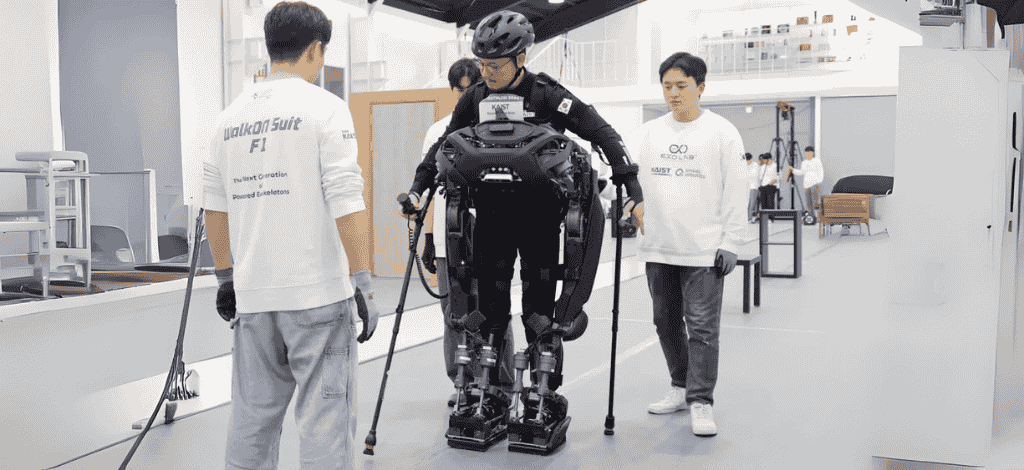
Introduction to the WalkON Suit F1
South Korean researchers at the Korea Advanced Institute of Science and Technology (KAIST) have unveiled an extraordinary innovation: the WalkON Suit F1. This lightweight exoskeleton robot is a game-changer for individuals with paraplegia, enabling them to walk, climb stairs, and navigate their surroundings with remarkable ease.
The Inspiration Behind the Invention
Influence of Iron Man
The idea for the WalkON Suit F1 was inspired by the iconic superhero Iron Man. Park Jeong-su, a member of the KAIST team, envisioned creating a robot that could empower individuals with disabilities, much like Tony Stark’s suit enhances human abilities.
Design and Features of the WalkON Suit F1
Lightweight Materials and Structure
Constructed from aluminum and titanium, the WalkON Suit F1 weighs just 50 kg (110 pounds), striking a balance between strength and portability. Its design ensures comfort and mobility without compromising durability.
Motorized Joint Movements
The exoskeleton operates through 12 electronic motors that mimic natural joint movements. These motors enable users to walk at speeds of up to 2 mph, climb stairs, and perform complex motions such as sidestepping.
Advanced Sensory Capabilities
Sensors for Balance and Motion
Equipped with sensors that monitor over 1,000 data points per second, the suit can predict a user’s intended movements and maintain balance. This feature is critical for ensuring stability, particularly on uneven surfaces.
Environmental Scanning with Cameras
Front-facing cameras act as the robot’s eyes, identifying obstacles and changes in elevation. This technology compensates for the limited sensory capabilities of users with complete paraplegia.
User-Friendly Integration
Automatic User Lock-On Mechanism
One of the standout features of the WalkON Suit F1 is its ability to locate and attach itself to a user while they are seated in a wheelchair. This innovation eliminates the need for assistance during the setup process.
Ease of Operation
The suit’s intuitive design allows users to control it effortlessly, making it a practical tool for everyday life.
Real-Life Demonstration by Kim Seung-hwan
Walking Speed and Maneuverability
Kim Seung-hwan, a paraplegic researcher and team member, demonstrated the suit’s capabilities by walking, climbing stairs, and sidestepping onto a bench. His ability to move with such precision highlights the suit’s transformative potential.
Ability to Climb Stairs
The WalkON Suit F1’s ability to navigate staircases is a significant milestone, offering new possibilities for users to access previously inaccessible areas.
Achievements and Recognition
Winning Gold at Cybathlon 2024
Kim’s performance in the exoskeleton category at Cybathlon 2024 earned him a gold medal, showcasing the WalkON Suit F1’s excellence in assistive robotics.
Competitors in the Cybathlon Event
The competition featured other notable innovations, including Switzerland’s VariLeg Enhanced and Thailand’s ChiangMaiU EXO 2. These advancements highlight the global progress in exoskeleton technology.
Challenges in Exoskeleton Development
Adaptability in Daily Use
Despite advancements, exoskeletons face challenges in adapting to diverse environments and user needs. Designing systems that seamlessly integrate into daily life remains a priority.
Reducing Cognitive Demands for Users
Minimizing the mental effort required to operate these devices is essential for broader adoption and usability.
Future Prospects of the WalkON Suit
Integrating Artificial Intelligence
Future iterations of the WalkON Suit F1 could incorporate AI to enhance responsiveness and adaptability, further simplifying user interaction.
Enhancing Accessibility
Reducing costs and improving accessibility will be critical for ensuring that more individuals can benefit from this technology.
The Broader Impact of Exoskeleton Technology
Empowering Individuals with Disabilities
Exoskeletons like the WalkON Suit F1 empower individuals with disabilities to regain independence and participate more actively in society.
Revolutionizing Rehabilitation
These devices also hold promise for revolutionizing rehabilitation, aiding in recovery for individuals with spinal cord injuries or neurological conditions.
Personal Stories of Impact
Kim’s Vision for His Family
Kim’s motivation to walk again stems from a desire to share meaningful experiences with his son. His journey is a testament to the transformative power of assistive technology.
Testimonies from Other Users
Other users have shared similar stories of regained mobility and independence, highlighting the widespread impact of such innovations.
Comparisons with Global Innovations
Switzerland’s VariLeg Enhanced
The VariLeg Enhanced exoskeleton offers a hybrid design, seamlessly transitioning between a wheelchair and a walking aid.
Thailand’s ChiangMaiU EXO 2
With 10 degrees of freedom, the ChiangMaiU EXO 2 enables a broader range of movements, including lateral locomotion.
The Role of Competitions Like Cybathlon
Driving Innovation in Assistive Robotics
Competitions like Cybathlon play a crucial role in advancing the field, encouraging developers to push boundaries and address real-world challenges.
KAIST’s Vision for the Future
Long-Term Goals of the Exoskeleton Lab
The team at KAIST aims to refine the WalkON Suit F1 further, focusing on usability, affordability, and widespread adoption.
Conclusion
The WalkON Suit F1 represents a monumental step forward in assistive technology. By blending advanced robotics with user-centric design, this exoskeleton is not just helping people walk—it’s transforming lives.
FAQs
- What is the WalkON Suit F1?
The WalkON Suit F1 is a lightweight exoskeleton designed to help paraplegic individuals walk, climb stairs, and navigate various environments. - Who developed the WalkON Suit F1?
The exoskeleton was developed by the Exoskeleton Laboratory team at KAIST in South Korea. - What makes the WalkON Suit F1 unique?
Its standout features include a lightweight design, motorized joint movements, advanced sensory capabilities, and an automatic lock-on mechanism. - What challenges do exoskeletons face?
Key challenges include adapting to daily life, minimizing cognitive demands, and improving affordability and accessibility. - What is the future of exoskeleton technology?
The future includes integrating AI, enhancing usability, and expanding access to empower more individuals worldwide.
Source: Google News
Read more blogs: Alitech Blog
Tags: Iron Man-inspired exoskeleton, WalkON Suit F1 robot, South Korean exoskeleton, KAIST exoskeleton lab, exoskeleton for paraplegics, wearable robot for disabled, robotic walking aid, advanced assistive technology, exoskeleton innovation 2024, Cybathlon 2024 exoskeleton, paraplegic mobility solutions, lightweight exoskeleton design, robotic mobility suit, sensors in exoskeletons, assistive robotics technology, walking aid for wheelchair users, robotic rehabilitation tools, artificial intelligence in exoskeletons, robotic suit for climbing stairs, future of exoskeleton technology

Zeeshan Ali Shah is a professional blog writer at AliTech Solutions, and Realancer renowned for crafting engaging and informative content. He holds a degree from the University of Sindh, where he honed his expertise in technology. With a keen eye for detail and a passion for staying up-to-date on the latest tech trends, Zeeshan’s writing provides valuable insights to his readers. His expertise in the tech industry makes him a sought-after writer, and his work at AliTech Solutions has earned him a reputation as a trusted and knowledgeable voice in the field.



Leave a Reply