


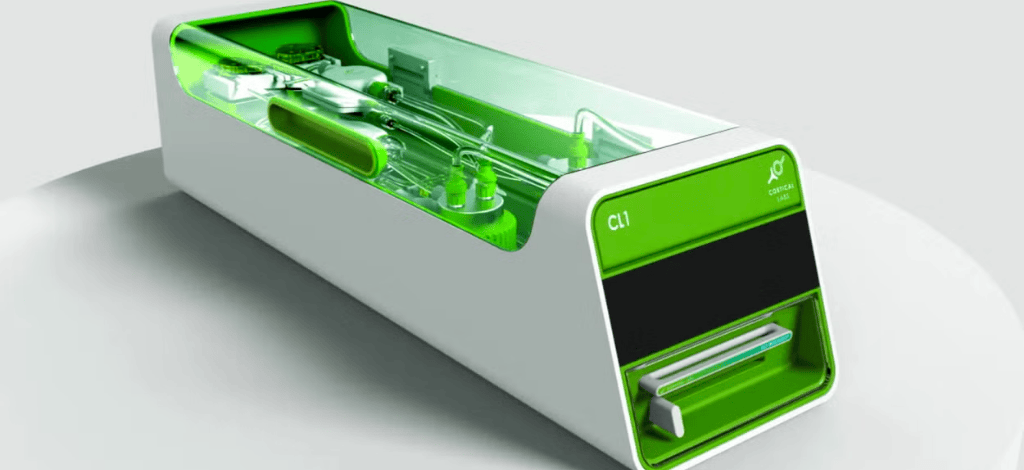
Cortical Labs, an Australian startup, has unveiled the world’s first commercial biological computer, the CL1. This revolutionary device operates using living human brain cells, merging biology with technology to create an innovative approach to computing. The CL1, often described as a “body in a box,” could have profound implications for artificial intelligence, robotics, and neuroscience.
The Birth of a Biological Computer
Developed by Melbourne-based Cortical Labs, the CL1 was introduced at the Mobile World Congress in Barcelona. Unlike traditional computers that rely on silicon chips alone, this system integrates lab-grown human neurons that communicate through electrical impulses. These neurons form networks on a silicon chip, creating a dynamic computing structure capable of learning and adapting in ways that traditional AI struggles to replicate.
How CL1 Works
At its core, the CL1 operates through the Biological Intelligence Operating System (biOS), which allows programmers to interact with the living neurons. The system is supported by an internal life support mechanism that includes pumps, gas regulators, and temperature controls to keep the neurons alive for up to six months. This setup enables users to deploy code and execute computing tasks in an entirely new way.
Learning and Adaptability
One of the most remarkable aspects of the CL1 is its ability to learn and adapt with minimal data and power consumption. Traditional AI models require vast datasets and immense computational power, whereas biological intelligence has evolved over billions of years to perform complex tasks efficiently. This approach significantly reduces energy consumption while improving adaptability.
Teaching Neurons to Play Pong
A notable milestone in the development of biological computing was the experiment in which lab-grown neurons were trained to play the video game Pong. Researchers found that these neurons could learn from stimuli and adjust their responses accordingly. This demonstrated the potential for biological AI to develop pattern recognition and decision-making abilities similar to a human brain.
The Ethical Debate
The rise of biological computing has sparked ethical discussions regarding the use of human brain cells in technology. While the neurons used in CL1 are lab-grown, concerns remain about the possibility of consciousness and sentience in such systems. Cortical Labs has implemented ethical safeguards, though the debate continues within the scientific community.
Applications in AI and Robotics
The potential applications of biological computing extend beyond gaming. CL1 could revolutionize fields like AI, robotics, and medical research. Biological AI systems could be used to simulate neurological diseases, test drug effects, and create more efficient, adaptive AI models. The ability of neurons to learn rapidly with minimal energy makes them ideal for tasks requiring dynamic adaptation.
CL1 as a Research Tool
Cortical Labs aims to make CL1 accessible to researchers worldwide. By democratizing biological computing, scientists from various disciplines can experiment with the technology to explore its potential applications. The “Wetware-as-a-Service” model allows remote access to CL1 systems, enabling researchers to interact with the neurons without specialized lab equipment.
The Energy Efficiency Advantage
One of the biggest challenges of modern AI is its energy consumption. Training large language models, such as ChatGPT, requires significant computational resources. Biological computing offers a potential solution by mimicking the efficiency of the human brain, which operates on just a few watts of power. This could lead to more sustainable AI development in the future.
What is Biological AI?
Biological AI is an emerging field that seeks to harness living neurons for computational purposes. Unlike traditional AI, which relies on algorithms and artificial neural networks, biological AI utilizes actual neurons to perform tasks. This approach has the potential to create more flexible and adaptable systems that function similarly to biological brains.
The Role of Lab-Grown Neurons
The neurons used in CL1 are derived from stem cells, which can be reprogrammed to develop into brain cells. These neurons form interconnected networks that can process information and respond to stimuli. This technology allows researchers to explore how biological systems solve problems and adapt to new environments.
Potential Medical Applications
Beyond AI and robotics, biological computing could have significant medical applications. By studying how neurons interact and learn, scientists could gain insights into neurological disorders like Alzheimer’s and Parkinson’s. This could lead to new treatments and a better understanding of brain function.
The Future of Hybrid Computing
The development of CL1 marks the beginning of a new era in computing. Hybrid systems that combine biological and silicon-based processing could pave the way for more efficient and intelligent machines. These systems could bridge the gap between artificial and biological intelligence, offering new possibilities in AI development.
Challenges and Limitations
Despite its promise, biological computing faces several challenges. Maintaining living neurons outside the human body requires precise environmental conditions. Additionally, the technology is still in its early stages, and further research is needed to determine its long-term viability and scalability.
CL1’s Commercial Availability
Cortical Labs plans to release the first CL1 units in June, with each device priced at approximately $35,000. The startup envisions a future where biological computing is widely accessible, empowering researchers and innovators to explore its full potential.
Conclusion
The CL1 biological computer represents a groundbreaking shift in the world of technology. By integrating living neurons with traditional computing, Cortical Labs has opened the door to new possibilities in AI, robotics, and medicine. While challenges remain, the potential benefits of biological AI could reshape the future of intelligent computing.
FAQs
1. What makes CL1 different from traditional computers?
CL1 uses living neurons to process information, allowing it to learn and adapt more efficiently than conventional silicon-based computers.
2. Can CL1 think like a human?
No, CL1 is not capable of human-like thought or consciousness. It processes information based on neuronal activity but does not have self-awareness.
3. What are the ethical concerns surrounding biological computing?
Ethical concerns include the use of human brain cells, potential consciousness in neuron-based systems, and the long-term implications of merging biology with AI.
4. How does CL1 compare to traditional AI models?
CL1 requires significantly less energy and data to learn, making it a more efficient alternative for certain AI applications.
5. When will CL1 be available for purchase?
Cortical Labs plans to release the first CL1 units in June, with a price tag of approximately $35,000.
Read more blogs: Alitech Blog
Tags: world’s first biological computer, Cortical Labs CL1, human brain cell computer, biological AI technology, hybrid computer system, neuron-powered AI, lab-grown neurons in computer, future of artificial intelligence, biological intelligence operating system, CL1 biological computer applications, ethical concerns of biological AI, energy-efficient AI models, neuroscience and AI integration, biological computer for robotics, lab-grown brain cells in AI, teaching neurons to play Pong, potential medical applications of biological AI, AI with living neurons, CL1 commercial availability, challenges in biological computing, future of hybrid AI systems

Zeeshan Ali Shah is a professional blog writer at AliTech Solutions, and Realancer renowned for crafting engaging and informative content. He holds a degree from the University of Sindh, where he honed his expertise in technology. With a keen eye for detail and a passion for staying up-to-date on the latest tech trends, Zeeshan’s writing provides valuable insights to his readers. His expertise in the tech industry makes him a sought-after writer, and his work at AliTech Solutions has earned him a reputation as a trusted and knowledgeable voice in the field.



Leave a Reply